So, that day, that memory that I alluded to earlier. If I were telling it as a story, I might imply that it started like any other day. Indeed, it may well have done so. On this particular day, however, there was mystery afoot, a plot bubbling beneath the surface of our working-class existence in suburban Teignmouth. I was blissfully oblivious, even when dragging my suitcase down the hill of Kingsway and huddling in a shrouded, leafy enclave with my mother and sisters as we waited for something, someone who was destined to take us away from home. I was probably told that we were going on an adventure, which would have appealed to my mind and made the reality far more exciting than it actually was.
Like any good escape in the movies, there always seems to be an element of luck involved, a roll of fate’s dice that will determine the outcome. If anyone had visions of ‘Little Me’ wandering around the garden discreetly depositing soil from Tom, Dick or Harry tunnel over the flowerbeds, I’m afraid you’ll be somewhat disappointed by what follows. No forged papers, no disguises…not even a cameo appearance by Steve McQueen or James Garner.
As our bid for freedom unfolded, it transpired that somehow, my father had got wind of what had happened, perhaps a tip off from an overly zealous neighbour and pulled up alongside us in a white car, driven by a man we knew as Uncle Don, whose surname escapes me, but I think I recall that he was a decent man. And so, temporarily abandoned by fortune, we trooped back up the hill, a dark and oppressive cloud hanging over us all, although I still didn’t really understand what was going on. I spent the rest of the afternoon in a similarly confused state as whispers were whispered and arguments were, well, argued. Our social worker arrived, a chap called Mr Day, who wore a brown suit and was accompanied by the smell of stale cigarette smoke and coffee, an odour to epitomize the seventies. He also spoke…very…slowly…which amused us children no end and we would regularly mimic his voice after his visits. To be fair, I’ve never envied social workers their jobs and our family, such as it was, must have been a challenge to work with.
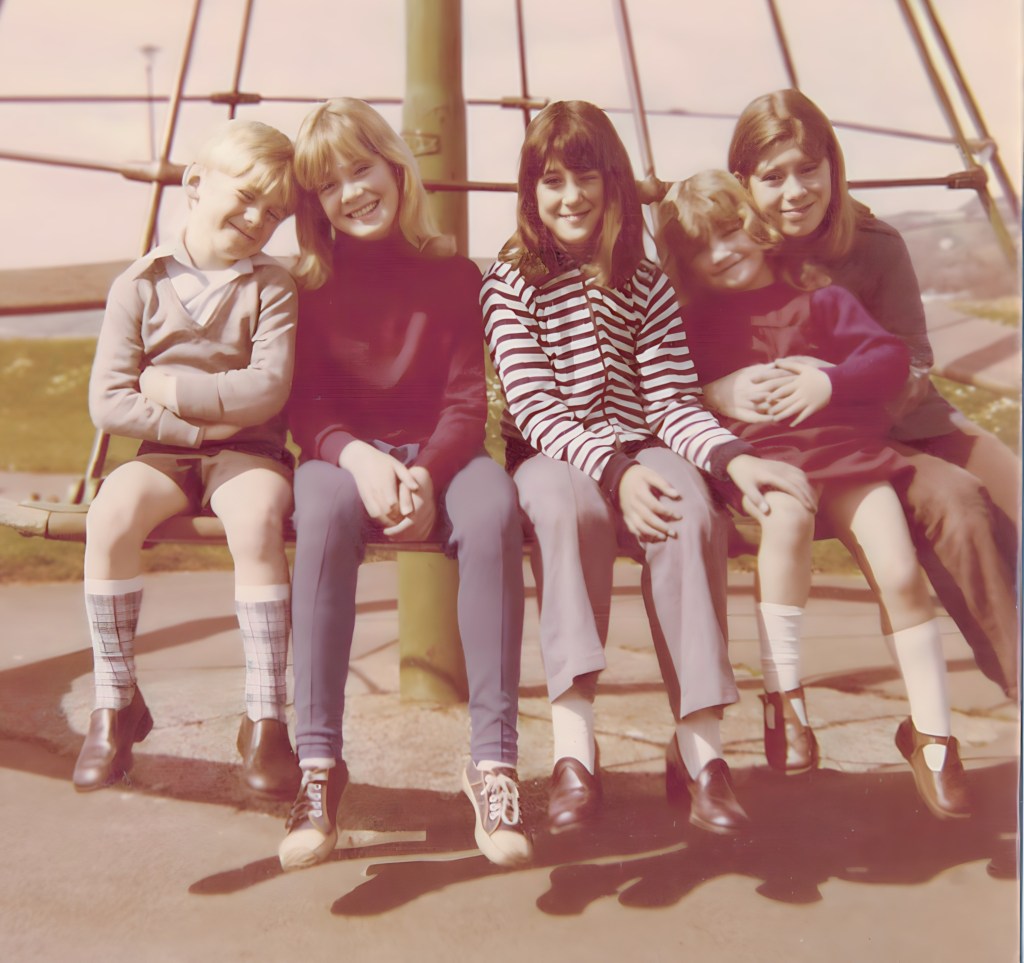
I don’t know what the girls were all thinking while these surreptitious conversations were taking place, but I remember suddenly feeling that something definite, something huge and scary was happening, that we were all moving towards a place from which there would be no return. I don’t recall the effects that living in such a disjointed, dysfunctional family unit had on my sisters at the time, but if the rock-throwing incident was anything to go by from my perspective, it must have had an equally profound effect on them. With age and experience on my side, I can look back now and understand how the ever-present threat of violence taught me to rely on my instincts, taught me to watch for signs in people’s behaviour, even at the relatively tender age of what, six years old? It’s something that I’ve never really stopped doing and has doubtless contributed to my tendency to overthink social situations at the age of 52. It’s also likely that it’s where my glass-half-empty outlook emanates from, so much so that it long ago became far worse than a glass half-empty as my glass is chipped, cracked, dirty and filled with a liquid that is frankly undrinkable.
Anyway, back to those whispered exchanges and the air of despondency so thick that it clouded the entire house like a blanket of depressing fog. Eventually, we were all called into the kitchen and the situation was explained in its simplest terms. Mum and Dad weren’t going to be living together anymore. So, we had to choose, there and then, who we wanted to live with. It still hurts me now when I think about it. I remember that I was the last to decide and that afternoon in the dingy, little kitchen, where I had broken my toes and where my youngest sister, Ellie, had once fed the dog (Sheba, an Alsatian) an entire box of Weetabix, all the milk we had and a bowlful of sugar for its breakfast, is burned into my mind. One by one, my sisters crossed the kitchen floor under the watchful eye of all concerned to stand next to my mother. I didn’t know what to do, but I looked at my father and I saw a broken man. Now, that’s not to say that I didn’t or don’t sympathise with what my mother went through; in fact, I’ll come to that later. But in that moment, I saw beyond the aggression and the violence, through the anger and the arrogance and I knew that I couldn’t let him be on his own. Call it a hunch, call it instinct, maybe even a sixth sense. Years later, he admitted to me that had I made a different choice that day, then he wouldn’t have lived the life that he did. You may think that my choice in that darkest of moments might have earned me some sort of reprieve or favoured treatment. Unfortunately, I don’t think the Universe works that way.
After that day in the kitchen, my memories of our timeline become a little blurred. There were so many comings and goings and I have memories of when the girls were there and when they were not, even after they all left, I think they came back. There were bitter custody battles to rival the notorious Kramer vs Kramer movie and if you wonder about the level of the physical harm in the relationship between my parents, in my opinion, it was nothing compared to what went on after they separated. My father drank more and his behaviour became more volatile, his frustrations bubbling ever nearer to the surface, probably fuelled by his feelings of inadequacy and failure. In the absence of my mother, it doesn’t take a genius to work out where his frustrations landed.
The custody battles and the subsequent behaviour surrounding them are still what hurt the most to this day. One Christmas, we were told that we (myself and any combination of the girls, so frequent were the changes in personnel at home in both Teignmouth and latterly Ideford that I can’t recall exactly who was involved) couldn’t see our mother because she had died. Take a moment, because I know that I probably seem a little blasé in dropping that into the narrative. But how fucked up would you have to be to consider that as an appropriate lie to tell your children? To make them grieve for their mother in the knowledge that what you had told them was untrue. Of course, I now know how fucked up he had to be to even consider that and I understand that he suffered a traumatic childhood himself. That doesn’t and never will excuse some of his actions around this time, but it does explain it and I’m far more at home with understanding why somebody did what they did when the alternative is much more concerning to me.
Similarly, I can remember being marched down to the phone box in Ideford to call my mother and tell her that I didn’t want to come and spend Christmas with her. No reason given, I was just told to say that I didn’t want to. As you can probably guess, it was the very opposite of what I wanted to do, but I didn’t have any say in the matter. So much of my childhood was spent obeying the command to ‘do as I was told’ or to ‘do as I say, not as I do’. The short walk back past the Royal Oak pub was a great deal colder than the December air could ever have made it with the numb, frozen heart that I carried chilling me to the bone.
At some point, those custody battles ceased to have anything to do with the welfare of the children and, in my admittedly inexperienced opinion, became more about point-scoring and hurting the adults who were involved. Any semblance of family, any possibility that we siblings could have had of living a normal life and conducting anything approaching balanced relationships with each other was torn away from us during those days and the months that followed. To my frustration, no-one has ever really accepted responsibility for the pain that was inflicted upon us during these times and I’ll try to explore the impact that it had on us further in these pages.
In many ways, I was more fortunate than my sisters, who, over the course of time, ended up in care homes as the impact of their situation and the damage determined by others affected their behaviour and their relationships. For whatever reason, despite my father’s drinking and the physical violence, we got by, we survived. Just. And when I say just, I don’t say it lightly. There were times when food was in such short supply that we would have to get by on a tin of spaghetti for a whole weekend. It sounds laughable, doesn’t it? But laughter was in short supply. One terrible night in particular stands out…
Copyright Alec Hepburn, 2025.
 A Life More Ordinary
Leave a comment