It had been a busy day in the seaside town of Teignmouth, the sort of day that publicans loved as it precipitated heaving gardens and thirsty punters. The sun had shone and the beaches had been busy, ‘early busy’ too, as families had fought for space to lay down their towels before the sea had barely begun to recede from the shore. Local businesses had enjoyed a profitable summer so far and the weekly influx of ‘grockles’, as the residents named the ‘not-we’, looked set to increase as July gave way to August and sales of buckets, spades and meaningless plastic tat went through the roof.
The London Inn, a good stone’s skim away from the Back Beach and arguably the busiest pub in Shaldon, was enjoying a livelier than usual Tuesday evening as children played on the green at the front of the pub, parents closely watching over the tops of pint glasses from packed benches that sat beneath slightly discoloured walls and a string of opaque, coloured light bulbs that struggled to throw muted reds, greens and blues further than three feet from the open, wooden door above which they were hung.
Inside the pub, it was busier still, where men elbowed their way throught the crowd to the bar, their bell-bottoms sweeping the floor as they tried to make themselves heard over both the natural din of the congregated drinkers and the hideously oversized collars of their tight-fitting shirts. Behind the bar, through a thick fog of cigarette smoke, the landlady grinned a toothy grin amid idle chatter, her long, brown hair just beginning to show the first signs of being within noticeable range of middle-aged. Meanwhile her husband, puffing on a Rothmans and dropping ash as grey as the colour of his hair onto his impeccably pressed white shirt, stuffed another handful of pound notes into the till, mentally planning the holiday they would take when the holiday season had finished and autumn arrived in the town to whisper its chilly reminisces through the narrow, litter-strewn streets.
Beyond the heaving masses, out past the toilets and the corridor that was lined with empty silver barrels, was a small, concrete garden that housed yet more drinkers and a hydrangea bush that was bursting with life, the odd lazy bee circling the flowers despite the late hour and the drop in temperature. Sat alone at one of the tables, a small boy with an unfortunate haircut that only served to draw attention to his white-blonde hair, stared solemnly into his glass that had been empty for about two hours, the Muppets on his t-shirt clearly having a far better time than he was. He looked over towards his father, deep in conversation with a woman some seven or eight years his junior, her shoulder-length, dark hair falling over a brown roll-neck jumper (or roller-neck as the boy would have called it, his fashion sense strictly limited to t-shirts displaying the creations of Jim Henson and blue-checked shorts that really were quite short).
The boy’s father shuffled off towards the bar in search of another drink and the woman gave the boy a look that he didn’t understand. Had he been older, he might have recognised the pity in her eyes. He might even have picked up on the slight irritation at his existence, but he knew little of such things, so he simply said nothing, focusing on hiding his disappointment when his father returned with two drinks, neither of which was for him. His stomach rumbled as an empty crisp packet, long since devoid of said crisps, rustled beneath the dirty ashtray beside him as it was caught by an errant breeze.
The evening seemed to drag on and on, with little else for the boy to do but shiver and look up at the stars. He was tired and seemed to be the only person in the pub who wasn’t having a good time. He wondered if the children that he’d seen out the front earlier were still playing and pondered why he hadn’t been allowed to join them, before his solitude and thought processes became too painful so he brought that particular train of thought to a shuddering halt.
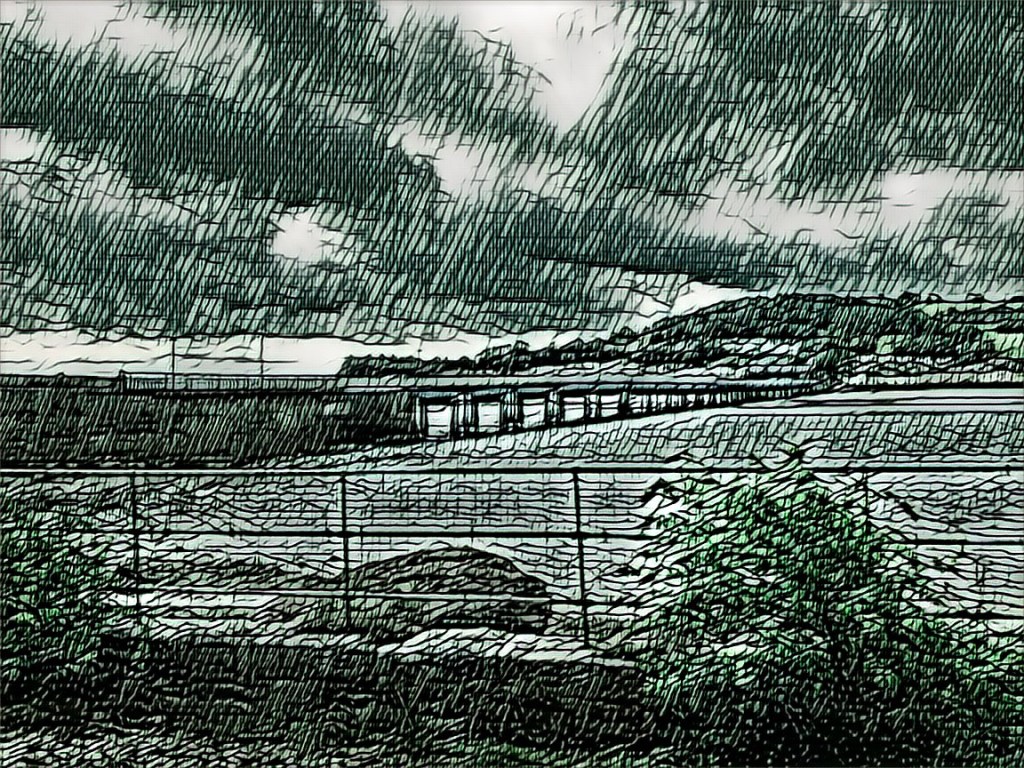
The conversation between his father and the woman petered out amid frustrated glances in his direction as other drinkers went on their way, unsteady on their feet, some positively glowing as their day in the sun without any form of skin protection caught up with them. The boy reached down towards his battered, school plimsolls and pulled his grey socks as far up his legs as they would go in a bid to retain the last of the warmth that he was feeling from the cooling patio and stone walls. Finally, when everyone else had gone and even the streetlights appeared to be thinking of calling it a night, the boy and his father left via the side gate, the silence only broken by the gentle lapping of the nearby waves and the sound of their footsteps. They reached Shaldon Bridge in just a couple of minutes and began their walk back towards Teignmouth, the dark water below visible through the railings at the side of the pavement.
About halfway across, maybe three minutes into their crossing, the boy’s father stumbled drunkenly, reaching out to steady himself against the metal supports. They had stopped beside one of the few lamp posts that lit the bridge, the two of them facing each other in the feeble glare of their very own spotlight. Instinct told the boy that something was wrong as his father looked down at the water below and his fears were confirmed as he watched a solitary tear run down his father’s cheek before launching itself from his bristly chin, swirling in the breeze as it plummeted towards the inky depths below. He gently reached out to take his father’s hand in his and frowned when his father pulled away.
It’s entirely possible that when you are small even the shortest of distances can seem far greater than they actually are and this was very much the case where the boy and the bridge were concerned. He imagined that the void beyond the side of the bridge was at least a hundred feet below them and that the waves beneath the concrete on which they stood must have hidden depths of fifty or sixty metres. Not only that, but he had very clear memories of a film that he had recently seen on television, the imaginatively titled ‘The Night the Bridge Fell Down’, a bridge that in his memory looked exactly like the one on which they now stood.
His father slowly reached up to the lamp post and used it to lever himself up so that he was standing on the railings.
‘Daddy? Daddy, what are you doing?’ asked the boy.
He was suddenly more afraid than he had ever been, which was quite an achievement given some of the things that he had already experienced in his short life. Whatever his father’s failings, and he suspected that there were many, he had never once indicated that something like this was on his mind. The boy was instantly taken back to the fateful day in the kitchen, when his mother and sisters left and he had made the choice to stay with his father, despite his fears and uncertainty.
‘I can’t…’ sobbed his father, his long hair ruffled by the wind, which to the boy at least was masquerading as an incoming storm, threatening to dislodge the person that he loved the most in the whole world from their precarious perch and even more precarious grip on life.
‘Daddy, don’t do it. I love you,’ the boy pleaded, his voice sounding fragile and insignificant, his words inadequate next to the struggle taking place before him.
‘You’ll be better off without me,’ cried his father. ‘All I do is mess things up. You don’t need me.’
With hot tears swimming in his eyes and panic rising from the pit of his stomach, the boy wanted to grab hold of his father’s legs and hug him so tightly that he wouldn’t be able to jump. He wanted to hold on to him forever and show him how much he loved him because he didn’t think that all of the words in the world would be enough right now. But he also knew that one false move could send his father toppling over the edge of the bridge and into the water below and while realistically the fall would have done him little harm, the amount of alcohol that he had consumed would certainly have impacted his ability to survive.
They stood there together for what felt like an eternity, the stars gazing down impassively in the night sky, the clouds intermittently scudding across their jet-black canvas. The boy was silently pleading for a miracle as his father remained tentatively perched on the precipice of indecision, moments away from stepping into the void and numbing the pain forever. A pain as old as the man himself, who had once been like the boy, full of naivety and ignorant to the suffering that life could cause. He was tired of that pain, the one that inhabited his every waking moment and beyond, the pain that he had brought to others, an echo of every injury and every failure that he had ever known. It went round and round, again and again. He couldn’t see a way to break the cycle. Unless he…
He took one step towards the blackness and the boy closed his eyes, screwing them shut tightly and wishing the most powerful wish that he could think of.
The boy never knew who or what intervened and occasionally, when he was brave enough to remember that night, he suspected that his father never knew either. But when he opened his eyes again that night on the bridge, to see the crumpled and broken man slowly and carefully clambering down from the railings before sinking to his knees beside him, he thought that miracles must exist, however rare they may seem and however difficult they may be to find. The boy launched himself at his father, raining kisses down upon him and sobbing as he wrapped his arms, his legs, his everything around his Daddy. Together, they wept. Cars drove past, a late-night train rattled along the rails at the near end of the bridge and the world continued to turn.
At some point before the sun rose, while the town slept on and the dreamers dreamed their dreams, they both got to their feet and walked home in silence, hand in hand. And that night was never mentioned again.
Copyright Alec Hepburn, 2025.
 A Life More Ordinary
Leave a comment