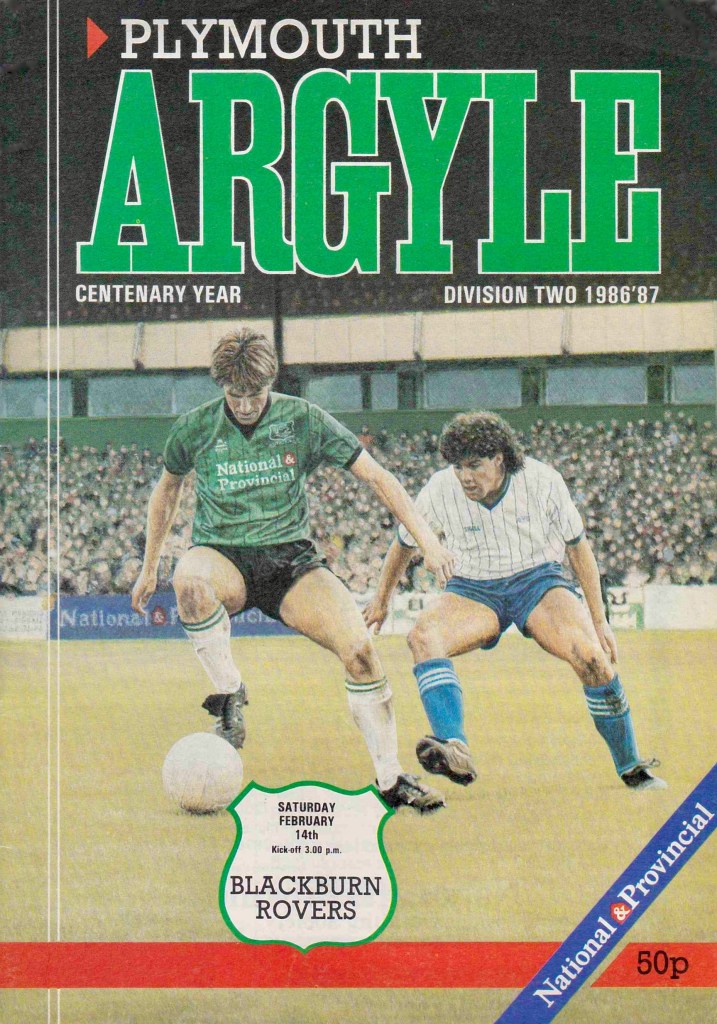
The programme cover of the first Argyle match I attended back in 1987.
Whisper it quietly, but when I first discovered football, I became a Manchester United fan (I suspect to my father’s disappointment, he would have loved nothing more than for me to follow in his Sunderland-supporting footsteps). I have no idea why I followed the Red Devils and perhaps that’s part of the reason why, on February 14th, 1987, I fell in love with Plymouth Argyle. It’s quite the switch, granted, but not one that I have ever regretted.
So, when did football get its claws in me? The first game that I ever recall seeing was the 1979 FA Cup Final, Arsenal v Manchester United. At home in Teignmouth, Cup Final day was quite the thing, watching the build-up and settling down just in time for ‘Abide with Me’. A classic cup final followed with Arsenal coasting into a 2-0 lead before a late United fightback, Sammy McIlroy’s 88th-minute leveller and my subsequent celebrations provoking a falling out with Alison of Rooney vs Vardy proportions. With the scores level at 2-2, it looked like the game would go to extra time until Alan Sunderland popped up to nab a late winner and break my little United-loving heart.
For the next few years, it was all about United. The 1983 cup triumph (via a replay) against Brighton was perfection, given that my stepfather was a Seagulls fan and, of course, two years later, Norman Whiteside was the hero when he fired past Neville Southall in extra time to end Everton’s hopes of cup success. At some point, I was given a birthday card signed by the entire United squad, which I was absolutely blown away by. Sadly, I have no idea what happened to it.
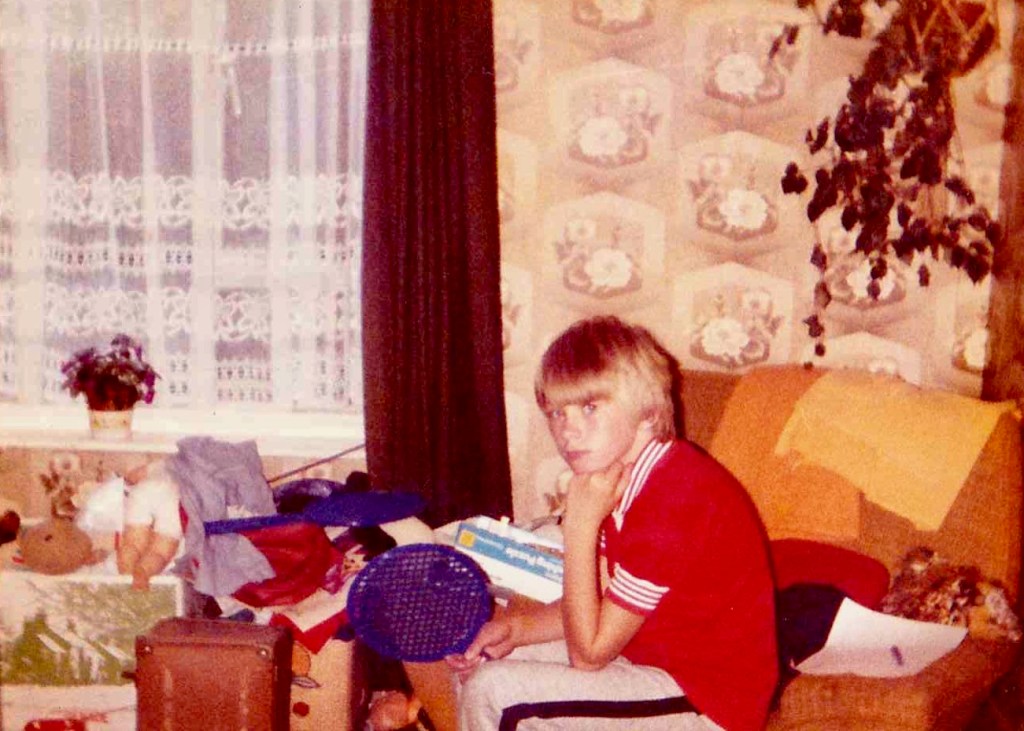
A picture of me wearing an old Manchester United top while sat looking pensive in Mother’s lounge. I’m probably wondering why my hair is still so horrendous.
After moving to Ideford in 1982, Saturdays consisted of a kick about in the frankly humungous garden that we had, trying not to lose the ball in the masses of hedges (mainly because it would be me braving the brambles and thorns in retrieving said ball). At some point during the morning, the newspaper would get delivered along with one of my two luxuries, Champ comic, which contained the magnificent comic strip ‘We are United’, so I would settle down to read that. Around 2 o’clock the ice cream van would make its weekly visit to the village, pulling up at the top of the hill (we lived at the bottom but with only eight houses in the road it wasn’t a huge inconvenience) and prompting a dash to beat the queue for a screwball, my other luxury, vanilla ice cream packed above a rock-hard bubblegum at the bottom presented in a plastic container that doubled up quite nicely as a home-made Dalek once empty and clean.
By 2.45, I’d be in the lounge with Dad, the radio on, him lurking behind his copy of the Daily Mirror, me probably doing my best to try and be as quiet as possible. The next couple of hours would dictate the remainder of our Saturday in a simple equation. If Sunderland won, we would enjoy a harmonious evening. If they lost, Satan and his minions would descend upon number one, Church Road and condemn us to what felt like an eternity of misery and torture. Of course, if Sunderland were playing Manchester United, I’d be willing my team to lose. If they won, it would be entirely my fault and I would suffer the silent treatment until I had made up for something completely out of my control by completing an unspecified number of household chores.
Despite the endless trepidation around the outcome of Sunderland’s matches, those Saturday afternoons were mostly enjoyable. On reflection, it was only really sport that my father and I bonded over and we would go on to spend many a weekend listening to match updates, which, in the summer, would be traded for long afternoons watching either the Test match or the John Player League on Sunday Grandstand. Days like these formed the basis of my relationship with my dad as I moved into adulthood and we only really progressed beyond them towards the end of his life.
By the end of the 1984-85 season, we had moved to Plymouth. I’d been aware of Argyle during their FA Cup run of 1983-84 and despite now living in the city, I’d not made it to Home Park by the time they won promotion from the Third Division to what is now the Championship – although living in Westbourne Road in Peverell, we could always hear when Argyle had scored and none more so than the night they clinched promotion, thumping Bristol City 4-0 in front of ’20,000’ and the rest.
In the Second Division in 1986-87, Argyle hit the ground running and were becoming harder to ignore, back pages of the Evening Herald regularly catching my attention while on my paper round. In January 1987, they were drawn against Arsenal (top of the First Division) in the fourth round of the FA Cup, a game which would see them succumb to a 6-1 defeat against the likes of David Rocastle, Charlie Nicholas, Niall Quinn and Tony Adams.
Two weeks later, my stepbrother, Martin, offered me the chance to join him in watching Argyle take on Blackburn at home.
Once I’d committed to going, the excitement had started to build. My morning paper round had taken a little longer on the Saturday as I scanned every article in the sports pages of every newspaper in search of Argyle-related news. I was paid my week’s wages upon my return to the shop, which was followed by an interminable wait, the hours dragging by until we left home and headed towards Central Park. A quick stop at the pasty van by the entrance to the park yielded beef and potato (and assorted vegetable-based ingredients) goodness and we joined the steadily moving crowd to walk up the hill towards the ground. It was there that I felt it.
It started as a peculiar tingle in my fingers, accompanied by a nervous rumble in my stomach. A tiny, almost imperceptible shiver coursed down my spine as I looked around me, green and white scarves and bobble hats growing in number as we marched on. Half-heard conversations about the possible line-up, grumbles about the previous week’s defeat to Reading and the odd puff of tobacco smoke drifted over my head, We stopped to pick up a programme, the beginnings of one of my many hobbies, before we arrived at the entrance to the old Lyndhurst stand, pushing through the narrow turnstiles and making our way up the slight incline towards the terraces. Once at the top, I was afforded a moment of magic as the Home Park pitch blossomed into view, the grandstand opposite already filling up while the noise from the Devonport End briefly grabbed my attention before the momentum of the crowd carried me into the Lyndhurst stand and down towards the halfway line. Feet were shuffled, the murmur increased in volume and the atmosphere was like nothing I’d ever experienced. It was magical!
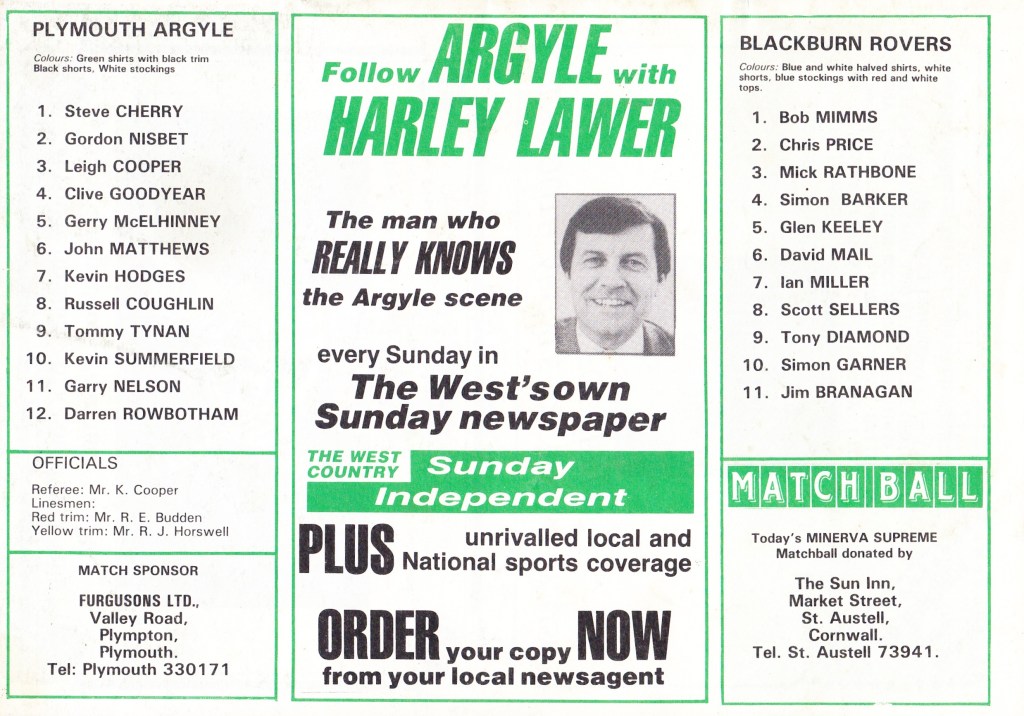
The back page of the programme from the Blackburn match.
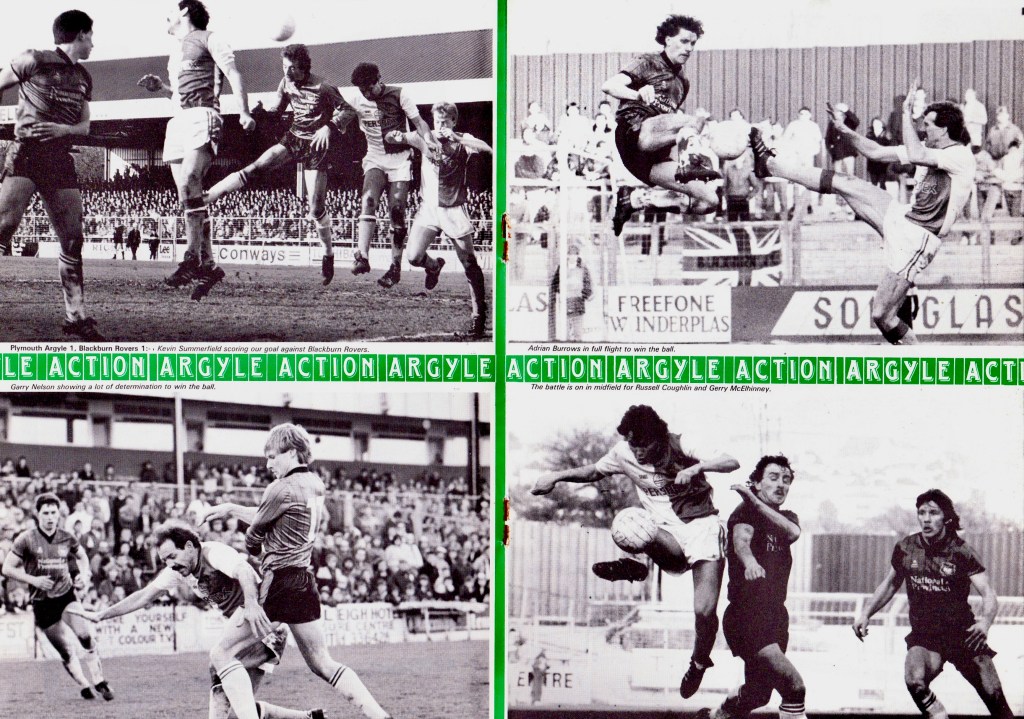
Out came the teams and within five minutes I heard the Argyle crowd vociferously suggesting that Steve Cherry, who had replaced fan favourite, Geoff Crudgington, in goal for the Arsenal cup tie, may have regularly enjoyed activities that involved one-handed reading and self-gratification. This dissatisfaction with the Pilgrims number one continued for much of the game, even after the 29th minute, when Kevin Summerfield headed past Bobby Mimms to give Argyle the lead. Blackburn were offered a golden opportunity to level early in the second half, when Gerry McElhinney was penalised for a foul on Keeley, with most of Home Park convinced that an equaliser was imminent. Barker’s spot-kick was well struck, but Cherry guessed correctly enough to block the ball with his legs, a chorus of ‘One Steve Cherry’ breaking out among the ranks of the Argyle faithful as the ball was cleared. If anyone ever doubted the fickle nature of football fans…
Blackburn did find an equaliser, but I was hooked. Plymouth Argyle were the team for me and from that day on, I never wavered. For better or worse!
Copyright Alec Hepburn, 2026.
No copyright infringement intended by the inclusion of the photographs from the Argyle v Blackburn match.
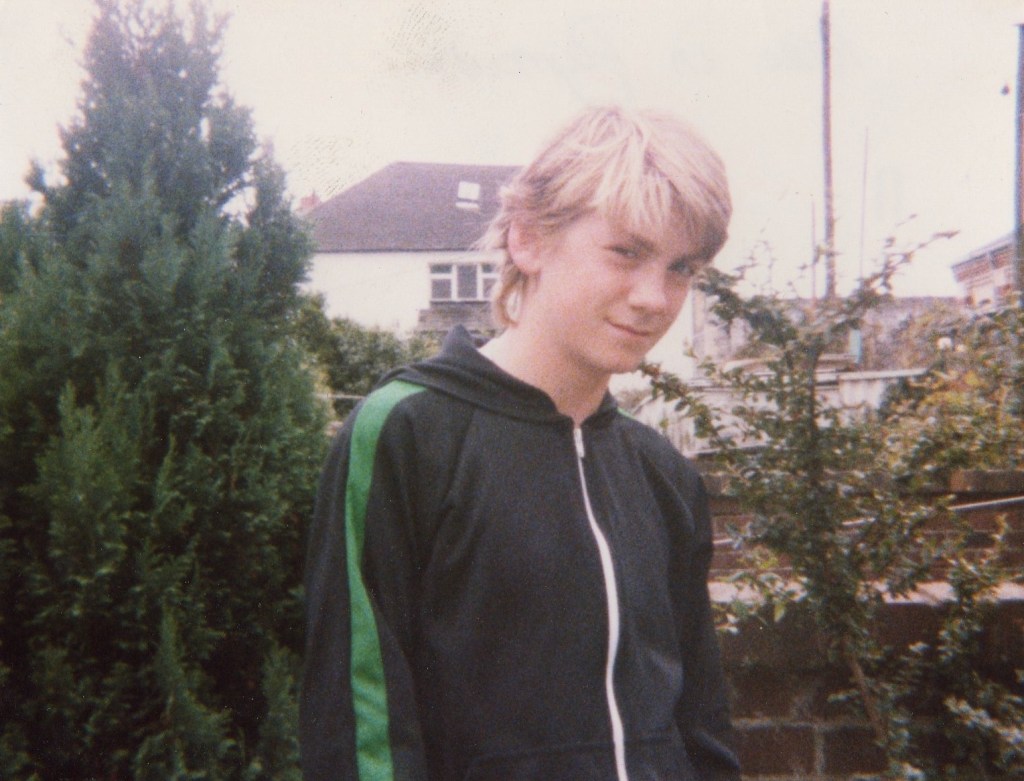
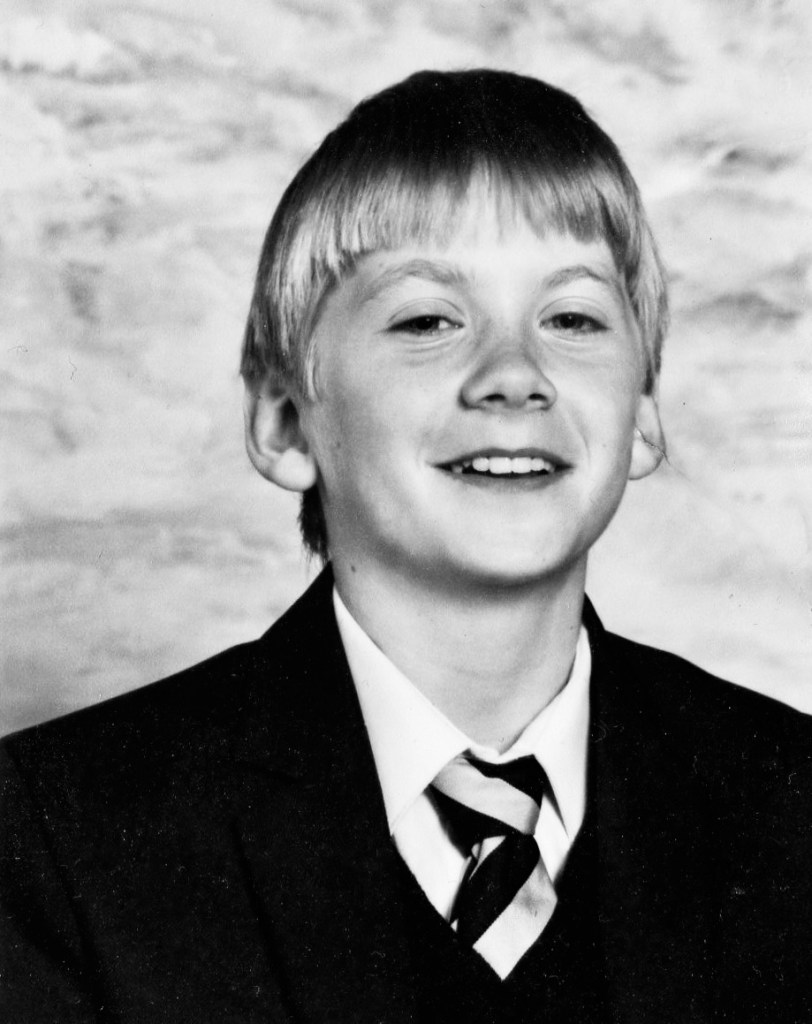
One of the few photographs of myself that doesn’t fill me with embarrassment.
Needless to say, at an all-boys school, opportunities to engage with girls were limited. At the time, the premises on which Devonport High School was situated were shared with a mixed school, Tamar High School, which was attended by a few of the students from Pennycross and, of course, the much-maligned apple of my eye, Joanne Kenny. After a lengthy settling-in period, which consisted entirely of keeping a low profile, I casually sought out redemption in the form of a request for another date with the girl I had wronged while taking my first, clumsy and ultimately, spectacularly irrelevant steps in the dating world. That request was politely and gently declined and I was left to conclude that that particular ship had sailed. So, I decided after a short period of time to lick my wounds, to ask Joanne’s friend, Alison, out. Great idea, eh? Nope.
Her surname escapes me, although I have a vague memory at the back of my mind that I’m not confident enough to commit to paper. Well, screen, but you get the gist. The more I’ve allowed my subconscious mind to process this particular part of my story, the more details have inched towards the different part of my brain that deals with what I think are facts. So, I’ll attempt to give an honest, if slightly hazy, recollection of my shortcomings in the dating world of the late eighties.
Alison was very quiet and by some miraculous fluke, I’d managed to appear attractive to someone who was far more shy than I was. Sadly, I was also still a colossal bell end. Armed with knowledge and experience now, I wonder if my failings in these early relationships were something to do with PDA (Pathological Demand Avoidance). It certainly is easier for me to stomach when I consider that I stood Alison up twice. On the first occasion, we had a genuine family emergency and I had no way of getting in touch with her to cancel the date, something which she was remarkably forgiving of. The second time, I had no such excuse; I simply got cold feet. I liked the idea of going out with someone, but I think deep down, I didn’t think that I was worthy of being liked, let alone of provoking any other positive feelings in anyone. So again, it was far easier to back out of the situation than to explore it and find out where it would lead. Once again, I incurred Joanne’s wrath and for what it’s worth, I felt like an absolute shit once I realised how much I had hurt Alison. As someone of limited self-esteem, I should have recognised our similarities and behaved accordingly. I didn’t and it still bugs me to this day. I also hope that I remember things correctly and that I didn’t behave any worse than the winds of time will allow me to recall. Either way, it suggests that when Jim Diamond sang that he should have known better back in 1984, he was absolutely looking into the future at this fourteen-year-old pillock. Perhaps my later relationships, when I was on the receiving end of similar insouciance was my comeuppance for these misdemeanours. What goes around comes around, don’t you know?
Sport at DHS was plentiful but missing cricket, much to my disappointment. In my five years at the school, we played one proper match, an inter-school friendly in the 1st year that I remember little about except for a leaping, one-handed catch that I took at square leg to dismiss arguably the best cricketer in the year, Scott Drawer. Scott and I had come to DHS as the only two students from Pennycross and he was the only person I knew upon starting my new school. We also shared the same birthday and for a time we got on well and were friends. He was a very good, all-round sportsman and was clearly driven to succeed and I suspect that ultimately the difference in our work ethic would prove to be a factor in us going our separate ways.
There was also a cricket tournament that the school entered at what is now the site of Harpers, owned by Plymouth Argyle, which I think was where Plymouth CC used to play. My solitary memory from that tournament was bowling at an opposing batter who drilled a straight drive high to my left. Seeing the ball straight off the bat, I flung myself full length in my follow-through and plucked a one-handed catch out of the air that slapped neatly into the palm of my hand! I always loved fielding and was fortunate enough to possess at least the basic skills that enabled me to pass as a half-decent fielder. Whatever my other limitations, I had that to fall back on!
During my fourth year at DHS, two or three of us were invited to take part in a county cricket trial, held at Plymouth College. We had maybe a handful of nets with one of the P.E. teachers, Mr Hayman, who was really enthusiastic about our attempts to get our skills up to speed in time for the trials in the ‘nets’ that we had available to us. This was the first time I had ever received any coaching (everything up to this point, including the switch from right to left-handed batter, was entirely self-taught) and I was thrilled to have someone who took the time to pass on a little advice. When we duly turned up to the magnificent facilities at Plymouth College, I suspect that we were somewhat overawed and while I don’t think any of us embarrassed ourselves, it was clear that we were out of our comfort zones. I would later gain my ‘revenge’ on the ‘posh boys’ in a club game and I hope you’ll indulge me when I recall that game a little further down the line.
Rugby never appealed to me; I was neither fast nor built like the proverbial brick outhouse, so focussed my time on football. While not always a regular starter, I suppose I was reasonably versatile playing in many positions over the years. I spent two years in goal at club and school, which was arguably my best position, but while a half-decent shot stopper, I was reluctant to throw myself at the feet of onrushing strikers. My solitary goal for the school came in a big win against an opposition whose name escapes me (unusually given my love of stats), where fellow midfielder, Tim Robinson and I rotated our positions to alternate forward roles in our attacking play, despite protestations from the manager. I got on the end of a forward pass, turned inside a defender and as the ball ran away from me, slid in to hook the ball beyond the oncoming goalkeeper and into the net.
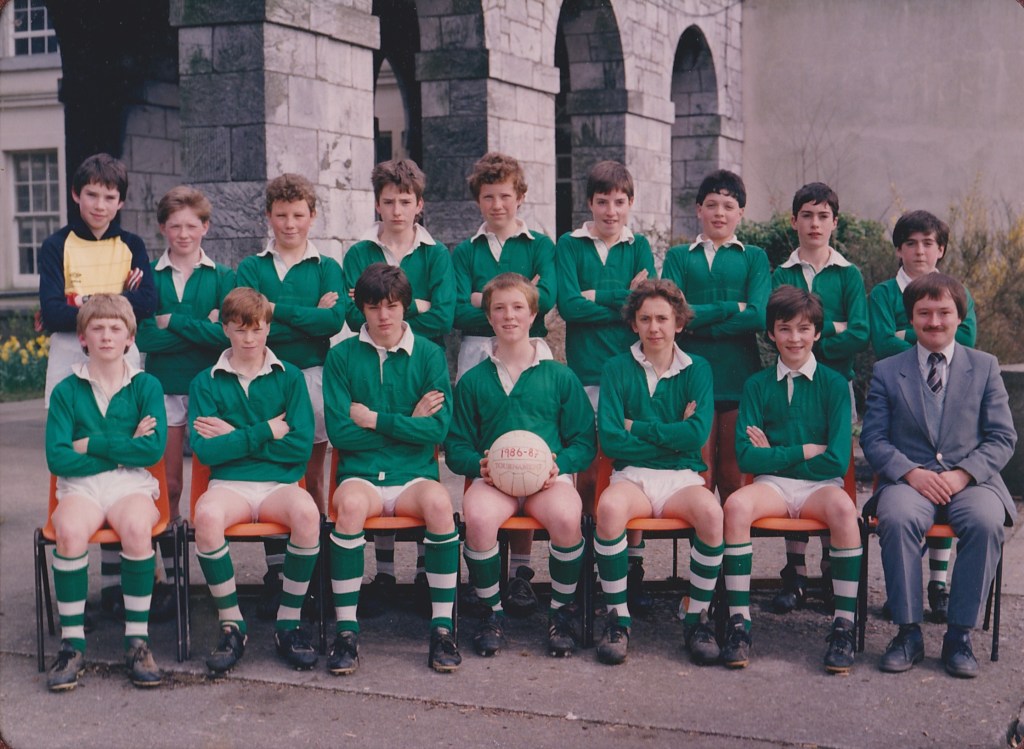
Our school football team at DHS. I don’t recall the exact year, but I clearly possessed the worst hair on the team.
The other issue that I had in retaining a place on the team was, I suspect, my inability to keep my gob shut and not take the piss out of the teacher running the school team, Mr Skinner, who was also my biology teacher during my final two years at school. I would regularly overstep the mark in classes. Nothing necessarily outrageous, but irritating and I’m not particularly proud of the way I conducted myself at DHS – self-sabotaging my education was a particular skill, but knowing what I now know about autism and PDA, I think there was probably more to it than labelling me a ‘badly-behaved’ child. In hindsight, I was fortunate to play as many games for the school team as I did. I certainly wouldn’t have picked myself with the knowledge and experience that I now possess!
One of the biggest issues that I faced during my time at DHS was that there was little support at home and the conversations around my progress were something along the lines of:
‘Have you done your homework?’
‘Yes.’
In truth, I struggled with most subjects due to a chronic lack of self-confidence and I masked that by trying to be funny. I felt destined for failure with most tasks that I undertook and if I’d managed to ask for help at home, I’m reasonably certain that it wouldn’t have been forthcoming, so I lied about having done my homework and did my best to fudge my way through school. I probably needed more help than I realised, but from year three onwards, I was reasonably confident that assistance at home was not really on anyone’s radar. In five years at DHS, I can only recall Dad attending one parents’ evening, which would have been during that first year when I was quiet and not so much of a gobshite.
That might sound like an unfair criticism. Things had become much less fraught at home after our move to Plymouth, although Dad clearly still had a temper on him, the embers of which would occasionally threaten to ignite something more spectacular. I’m not sure that Dad ever really ‘got’ what being a parent meant and as time went on, I certainly began to feel like an imposition on his time. I get it, work was important. He had ‘his own’ life to lead, but for much of my time under his roof, we felt to me like individuals all co-existing together. I don’t remember us doing much together as a family and during the five years I spent at secondary school, I can only recall one occasion where he came to watch me take part in a sporting fixture, a club cricket final where we lost to Saltash and I received an absolute howler of an umpiring decision (again, more to follow later).
I think there was also an expectation for me to be ‘ok’ with everything, perhaps because some of my sisters were arguably seen as having ‘bigger’ or more significant problems. While I was quieter, with issues that went under the radar most of the time, I probably just didn’t really get noticed. Even when we were in Ideford and Teignmouth and times were much more difficult, I was just expected to carry on regardless. Maybe I accepted that role and played it too willingly. I’ve always felt that my life has contained an element of self-preservation to some extent, obviously more so when I was a child and the next outburst or punishment lurked unseen around every corner. It’s part of the reason that I always choose my seat carefully in pubs and restaurants. I like to know when trouble is coming my way. On the rare occasions that I head out with friends, I am always on alert, listening to peripheral conversations and people watching. Anticipation was my most valued asset as a youngster and my experiences taught me to read people.
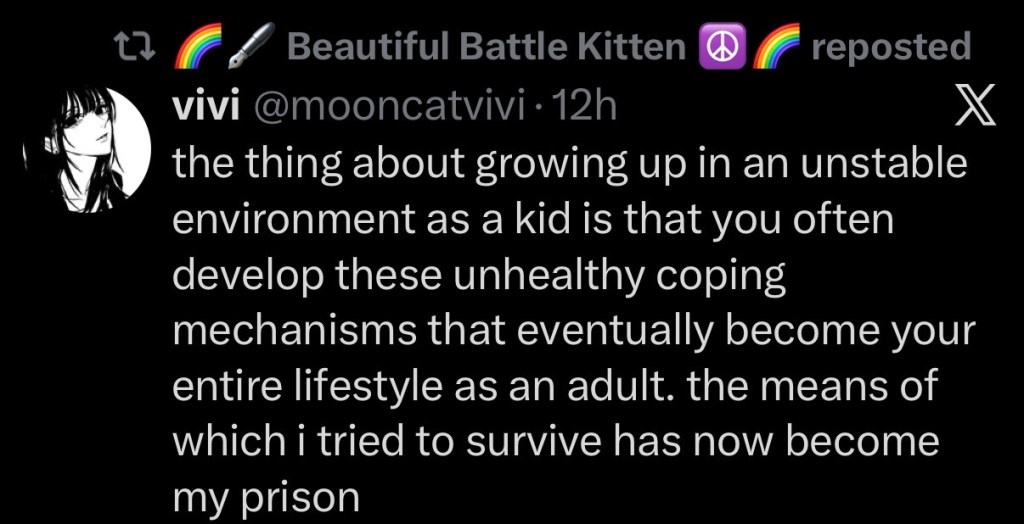
I saw this on social media just after publishing this post, so have edited to include it. It sums up much of what I was trying to get across in this update.
I loved my Dad; it’s important to state that before I go any further. I loved him despite everything that happened in my childhood. I do, however, think that he was quite a selfish person and that may draw criticism from some quarters, more so given that he is no longer here to defend himself. Some would say that he gave up work to look after me after he and mum separated, while I would argue that I gave up my childhood to look after him. We never had a family holiday that I can remember and once we moved to Plymouth with Brenda, his focus was on his new relationship. Again, given his life up to that point, I can understand that, in some ways, but I remember one conversation, years later, when discussing being a parent, when he ‘advised’ me not to love my children too much because they’ll ‘break your heart’. More than a little hypocritical in my eyes, but incredibly revealing about his state of mind. Neither of my parents were ever really able to accept responsibility for the way that their own children’s lives had panned out and it was somehow pitiful that my father’s takeaway from it seemed to be that he was the wounded party. In addition to the lack of emotional and educational support, he would regularly tell me that once I was 18, I was no longer his responsibility. I don’t think that he enjoyed the responsibilities of parenthood at all and I suspect that he was preparing for and looking forward to that moment for some considerable time.
Similarly, I also recognise and respect what Brenda did for him. There is no doubt that he changed after they met, generally for the better, and if they hadn’t crossed paths I’m not sure what would have happened to him. She was able to make him happy and for that I am grateful because I don’t think that he was a particularly happy person. Happiness for me is…difficult to achieve. I can’t remember if I’ve written this elsewhere on my blog, but contentment is far more attainable. It’s also less of a fall from contentment than happiness if life goes horribly wrong. It doesn’t mean that I don’t experience ‘happiness’, more that I’m less inclined to label it as such.
In year three at DHS (year nine in new money), Dad and Brenda took a two-week holiday. Very nice for them and while I probably sound a bit resentful, I didn’t begrudge them that – I guess that they wanted time away for themselves and didn’t want me tagging along and spoiling the atmos. I forget where they went, but it’s not terribly relevant. Italy? Greece? Somewhere far more exotic than the rows of semi-detached houses in deepest, darkest Peverell. What is relevant is that at the age of 14, I was suddenly alone in the house for a fortnight. Which at first was brilliant, but the novelty soon wore off. My stepsister would call in occasionally to check on me, but most of that time was spent on my own. No parties, I wouldn’t have been brave enough and in all honesty, I barely knew enough people to hold a conversation with, let alone a social gathering. It also wasn’t like I didn’t want to go abroad or on holiday, I was just never given the option. My holiday each year was visiting my mother in Horsham and substituting one dysfunctional family situation for another. But I guess they felt that maybe they had earned the right to make those choices at that stage in their lives and who am I to challenge that? Did it affect me? Yes, it did. Can I do anything about it? Absolutely not, but these moments, tiny or huge, have all combined to make me who I am today.
‘Every decision creates ripples, like a huge boulder dropped in a lake. The heavier the decision, the larger the waves, the more uncertain the consequences’– Ben Aaronovitch, 1988.
The same situation occurred in Year Four and perhaps most tellingly, in Year Five…right in the middle of my GCSEs. I wasn’t aware of things such as revision timetables during my exams; I had no structure, no guidance. No support. Maybe some of it was there and I simply didn’t access it, but by this point, I had buried my head in the sand and was blindly believing that I would somehow fluke my way to some adequate grades. In truth, that was never going to happen. I was constantly overwhelmed by the sheer amount of work required to succeed and aghast at the volume of knowledge that I was expected to retain across multiple subjects. English became my safe haven, my great hope because it was more about creativity and opinions, neither of which I have been short of over the years. I should have done much better in Biology, History and French as I didn’t despise the subjects or teachers and perhaps with a little encouragement or guidance I could have achieved more. Everything else, however, was very much a lost cause.
At sixteen years old, on the cusp of joining the ‘real world’, I was out of my depth in an education system that I didn’t really feel a part of. I sometimes wonder if the immaturity that I displayed during this time was a product of the loss of my earlier childhood. Was I subconsciously trying to claw back those lost years? Was I emotionally and socially underdeveloped and incapable of approaching my GCSE’s with clarity of thought and an understanding of consequences? Or had the expectation that I was ‘ok’ about everything just become a coping mechanism for me? I’d love to be able to let these thought processes go and perhaps in time, having told my story, I may find some peace. I hope so.
It’s no wonder that I never considered staying on into the sixth form and certainly no surprise that all I obtained with decent grades were my two English GCSEs. I’m not shifting blame; I didn’t work hard enough, I loved making people laugh and I was more interested in playing football and cricket. But I was unsupported, disenchanted and struggling with both my past and an undiagnosed disability. I felt horribly alone and lost for two weeks during the most important exams of my life. It was tough and many nights were spent in a state of panic, crying as the realisation of my lack of preparation descended upon me. Those feelings have never really left me.
While my early days at DHS were a bit of a mixed bag in terms of discovering who I was and ultimately who I wanted to be, an unpleasant memory surfaced recently that I’m hesitant about sharing…but this is supposed to be a look back on all that I remember, warts and all, so to speak.
I’ve already considered the fact that I had a gob on me when I was younger and there were occasions during my time at DHS where I earned a well-deserved whack or two from my peers as I traversed the fine line between being funny and being a complete tosser. However, there was one time when I was arguably worse than that, when I crossed paths at our local bus stop with a cheery-looking first year (my gap-strewn memory tells me that he was called Michael Hughes, who we also nicknamed ‘Smiley’ on account of his optimistic and innocent outlook on this new world that he had entered). I don’t remember a huge amount of detail about our encounters, but nothing that I did covers me in any sort of glory. One morning in particular, I was in a bad mood about something (probably impending trouble for not doing my homework) and Smiley turned up at the bus stop looking far too happy for my liking. So, I asked him why he was looking so ‘fucking happy’ and yanked his tie, like many had done to me on a daily basis, which sounds like I’m trying to make an excuse for my behaviour. I’m not; it was a stupid, unkind thing to do and completely uncalled for. I thought little of it at the time, but it upset young Smiley to the point of tears. That should have been the point where I realised my error…
Of course, the fact that I’m writing about this makes it obvious that no such moment of self-discovery took place. In fact, over the next couple of weeks, I probably made Smiley’s life particularly unpleasant. To this day, I couldn’t tell you why. Even the most amateur of psychologists would tell you that I was probably deeply unhappy with myself, which I was. You certainly wouldn’t need any qualifications to work that out if you’ve read this far. But what possessed me to take it out on a random twelve-year-old lad who never did me any harm? I obviously lacked the maturity to have those thought processes back then and I am deeply embarrassed and ashamed of my behaviour. You will be pleased to hear that justice was swift and effective.
I soon got wind of the fact that ‘Smiley’s Dad’ was after my blood. I had already clocked him from Smiley’s first few days of catching the bus, walking with his son on his new, big adventure and seeing him off to school safely, which, with the benefit of age and wisdom, I now see as a wonderful thing to do. To a group of gobby teenagers, however, it was a bit weird and overprotective. None of my business in the grand scheme of things though.
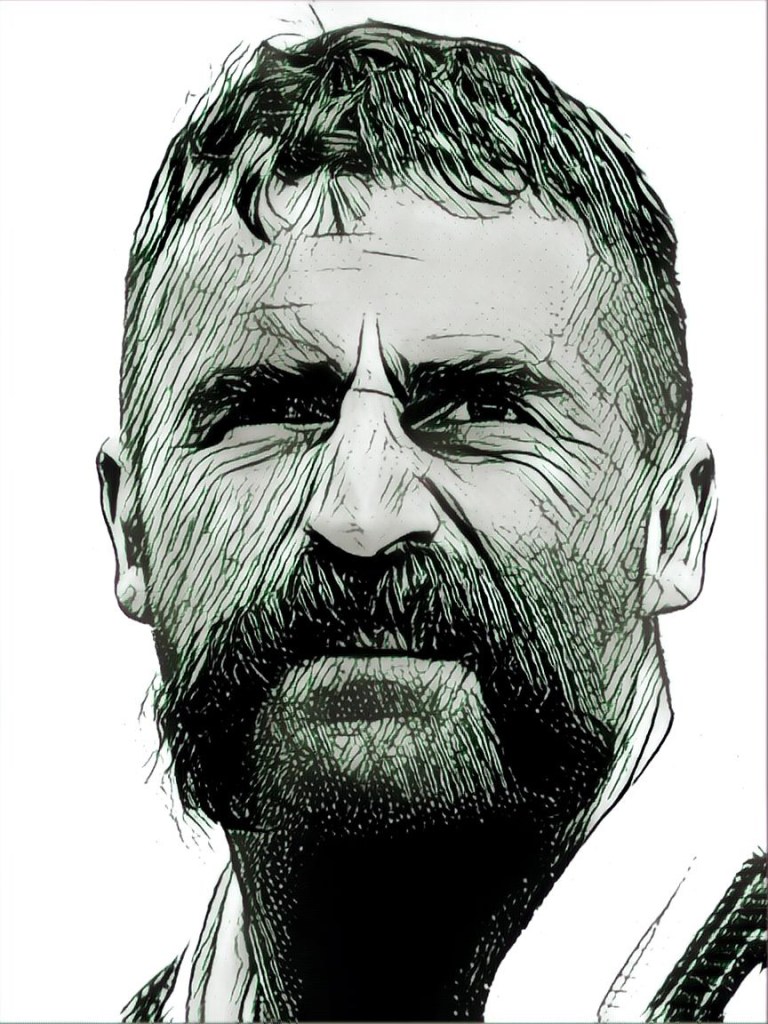
But back to Smiley’s Dad. He looked, through the hazy reminisces of time, a bit like the maverick Aussie fast bowler, Merv Hughes, but with longer hair that was flecked with wisps of grey that suggested he was clinging to middle age despite Father Time’s best efforts. He also looked like the sort of man that you really didn’t want to piss off, so by the time I discovered that I had done exactly that, there began a cat-and-mouse situation where I would avoid taking the bus, instead making the mile-and-a-half journey to school on foot.
Australian cricketer, Merv Hughes
After about two weeks of this, I lost patience and let my guard down, convinced that everything would have calmed down and that, in the grand scheme of things, it hadn’t been that bad anyway. What I didn’t reckon with was the fact that Smiley’s Dad was infinitely more resolute than I was. Sitting on the top deck of the bus, I was horrified to hear the excited cry of ‘It’s Smiley’s Dad’ from below stairs and even more terrified when the parent in question came snarling towards me like a hungry wolf who had finally cornered his prey. He grabbed me by the shirt collar and dragged me towards him as my arsehole threatened to expel my breakfast.
‘Think it’s clever to pick on someone younger than you, do you?’ his eyes bored into my very soul as I shook my head vigorously, any bravado that I had previously possessed failing to put in an appearance for good reason. I genuinely thought that he was going to hit me and I’ll be honest, I wouldn’t have blamed him if he had. The tirade continued and he made it very, very clear what would happen if I so much as breathed in the direction of Smiley from that moment on. I nodded furiously when he asked if I understood before he pushed me back against the window of the bus and strode away, through the crowd of silent onlookers. I said nothing, dwelling on the stupidity and cruelty of my own actions. I had well and truly got what I deserved and even after all these years, I can’t make a case for my behaviour. Suffice to say, I didn’t go anywhere near Smiley for the remainder of my time at DHS and on the few occasions that I saw him, he would give me a smug, knowing smile. Fair play to him.
I think that perhaps we don’t realise the implications that our words and actions can have during those difficult teen years. I’m certainly not trying to justify any form of bullying, there was an awful lot of it around at school, some that got dismissed as ‘banter’ and some that was far more serious.
Back then, I suspect that many incidents of that nature were dealt with in a similar way, which was obviously incredibly fruitful in terms of putting a stop to the behaviour. Did it educate me? No, it simply put the fear of God into me to make sure that I wouldn’t do that sort of thing again. Some might say that was education enough and they may be right. In time, however, what has been far more effective is the understanding that I made somebody feel exactly the way that I was made to feel during much of my childhood. It’s relatively easy to make light of the interaction with Smiley’s Dad, to laugh it off as ‘one of those things’. What doesn’t go away is the shame of having behaved like I did – even after thirty-odd years, so I suppose that there are short-term and long-term punishments. Either way, those were not my finest days.
At the risk of sounding incredibly old, it’s relevant when I say that at DHS, these were the days of blackboards and heavy chalk dusters, the wooden ones. It will surprise nobody to learn that even back then, riddled with insecurities and nervousness, I was partial to the odd chat or two. I received a detention (one of many) along with three or four others and the punishment was being overseen by the fearsome Mr Borbon, who lacked all of the sweetness and associated qualities of the similarly named biscuit, instead ruling classes with a stare that could curdle milk at a thousand paces and a temper of volcanic proportions. He also possessed, it turned out, a surprisingly accurate throw as I was soon to discover. Mid-conversation, I saw a movement in my peripheral vision and was fortunate to realise in an instant that the chalk duster was travelling rapidly towards my head. I was so, so lucky that I caught it, inches from my face, as it could have caused some serious damage. However, my lucky escape and sharp reflexes only served to enrage him further and he marched over to the table and dragged me from the classroom, depositing me unceremoniously on the floor outside and unleashing upon me the mother of all bollockings.
I reckon this was taken around 1986, so I would have been thirteen. Not sure what’s going on with the hair…
All of the above probably makes it sound like I was the sole perpetrator of misbehaviour in my classes, but nothing could be further from the truth. We could be quite brutal as a group and the entertainment that we conjured up during wet break times was violent, bordering on barbaric. I have no idea who came up with the idea for ‘Death Trap Alley’, but it was horrific.
The basic idea was that we would drag two rows of tables to face each other, leaving an ‘alley’ about three feet wide that we would have to fight our way through from one end to the other, while anyone who had already navigated the ‘alley’ would take their place on one of the tables and kick the living shit out of the next participant as they tried to battle their way through what was basically group-perpetrated physical assault. The trick, and by using the word trick I am by no means trying to make light of the process, was to get through as early and as quickly as you could. The longer you left it, the more people were involved and the number of injuries available to you would thus increase.
Similarly, we’d have games of Pontoon (also known as 21), but the losers of each round would have to cut the cards and whatever number was on the card that they uncovered would dictate the number of times that they would get hit over the knuckles with the full deck. If you drew a red card, you would receive relatively gentle hits, but a black card…well, the Kings of Clubs and Spades were feared for very good reason. This game, if I recall correctly, was known as ‘raps’ and would regularly lead to injured hands and bleeding knuckles.
Birthdays were no less traumatic and one of the few areas of my life where I could count myself ‘lucky’, as during four of my five years at DHS, my birthday fell during the October half-term. Those less fortunate than I were ‘treated’ to the bumps (face-down) before being thrown joyfully down the steep bank towards the playing fields. Some way to celebrate!
Despite my predilection for landing myself in hot water, there were a few teachers during my time at DHS who would occasionally offer support and encouragement. I recall enjoying French lessons, not because I had any particular affinity with the subject but because the teacher in question, Mr Jones, seemed like a really decent guy. He didn’t mind the odd joke if it didn’t go too far and he was thoughtful in his explanations – I’d say he was ahead of his time in understanding the differences in learning in individual students. Compared to my French teacher in my first year, Mrs Pierpoint, who called me out immediately in front of the whole class for daring to find humour in the pronunciation of the word ‘droit’, Mr Jones was a gift that seemed heaven-sent. I can still recall Pierpoint’s disparaging voice even now:
‘Ha, ha (she actually said the words ‘ha, ha’), very funny. Hepburn thinks that the word ‘droit’ sounds like twat.’ I did, and after that particular incident, I thought of a few extra words that Pierpoint might be a translation of.
I’ve always loved History and although I didn’t excel at it, I would try to do my best and enjoyed lessons with Mr Almond, who, if I remember correctly, was also involved in the Drama department and gave me the starring role in the 1st year production of A Christmas Carol. I’ve retained a love of looking back into the past and could have done far better than I did in History with the proper guidance and support. It remains a source of frustration that I didn’t manage to apply myself better.
I was fortunate enough to never have a bad English teacher and although I ended up in the bottom set, Mr Bowden was probably the best teacher for me and the one who allowed me to express myself most. I would regularly turn in lengthy (no surprise there!) essays and poems full of the most fantastic and outlandish ideas and always felt supported in his lessons. The best piece of work that I ever presented, a poem about winter, was marked at 92% and although I no longer have a copy of it, I remain incredibly proud of it. Probably sounds daft, doesn’t it? But as a perennial underachiever, who generally thought that everything they did was shit, that piece of work was my hope. My future.
The one thing that overshadowed every lesson that I took part in was an absolutely horrendous lack of self-belief, which I still carry with me to this day. I would sit in class dreading being asked questions and even in situations where I was confident that I knew the correct answer, there was no chance that I was ever going to raise my hand to issue forth my thoughts. In the classroom environment, I always felt small and insignificant and I’d rather sit quietly and let people assume that I was stupid than run the risk of being right. Being wrong would have been far, far worse, although so many of those fictional scenarios played out in my head would probably never have taken place. But I guess that I was a ‘safety first’ person and deep down, I suspect that I still am.
I had a natural antipathy towards figures of authority, likely fashioned from an existence where I was constantly being reminded that I was nothing, but two teachers managed to buck that trend, albeit occasionally and on a temporary basis. Deputy Head, Mr Faulkner, who could regularly be seen dashing along corridors, black cape flying behind him like an educational superhero, always speeding off in search of the next problem that needed a solution and occasionally fearsome yet always fair, Mr Burrows, who I recall possessed a moustache that would have made a Walrus proud and a wicked sense of humour. When I inevitably ended up sent in the direction of either teacher, they recognised that reason over rage was the best way to appeal to me and I’m sad that I never got the opportunity to thank them for their efforts – ultimately, my decision to leave Plymouth straight after my exams was hastened by the knowledge that I had underperformed and that once my father realised quite how badly I had done then I would be unavoidably in for the high jump, and I’m not talking about athletics. When you’re not necessarily one of the shining stars at a high-achieving school, it’s easy to just become a number. Worse still, if you are deemed to be difficult, you can feel lost, all at sea in a broiling ocean of uncertainty. I’d like to think that Mr Faulkner and Mr Burrows recognised that and did what they could to keep me afloat.
That performance of A Christmas Carol that I mentioned is also something that I was really proud of. With more confidence and support, I think I would have pursued an acting career, but the emphasis was always on getting a ‘proper job’. In my first major foray onto the stage (my only previous experience was as a wise man during the nativity play at Inverteign, carrying myrrh for those who might be wondering!) I somehow landed the role of Ebenezer Scrooge and I loved it! It’s my favourite of all Dickens’ works and I really threw myself into the role. I learned my lines obsessively, to the point where I didn’t make a single mistake during the entire performance and fully committed to the costumes, one of which was an old nightie that belonged to my younger sister, Ellie that I had to don during the ghostly visitations. ‘Scruffs’ at DHS weren’t generally well thought of; fewer still would earn the appreciation of their elders, but at the end of the performance in front of the whole school, we received an enthusiastic ovation and for a few weeks after, I would get the odd nod of approval while scurrying beneath the colonnade in direct contradiction of the ‘no running’ rule. The opportunity to be someone else for just a few minutes was something that hugely appealed to me; I could cast off my inhibitions, my insecurities and my past. I don’t have many big regrets, but I suppose this might count as one. Hi-diddle-dee-dee. An actor’s life could have very much been the one for me.
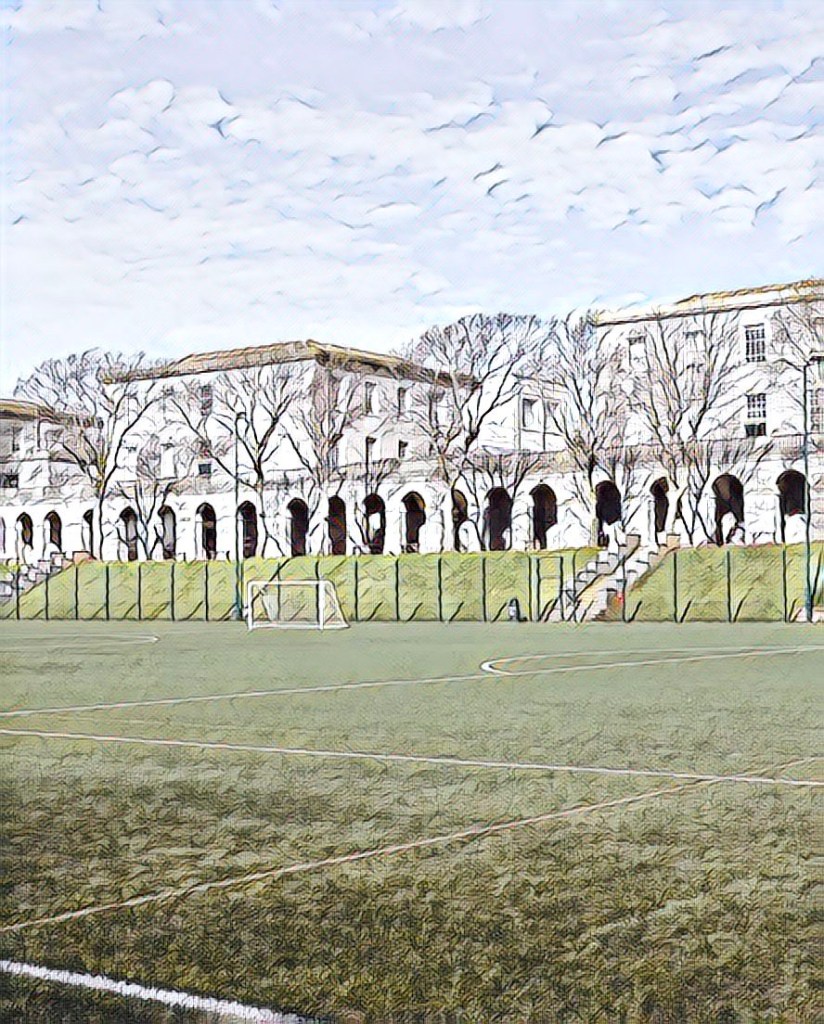
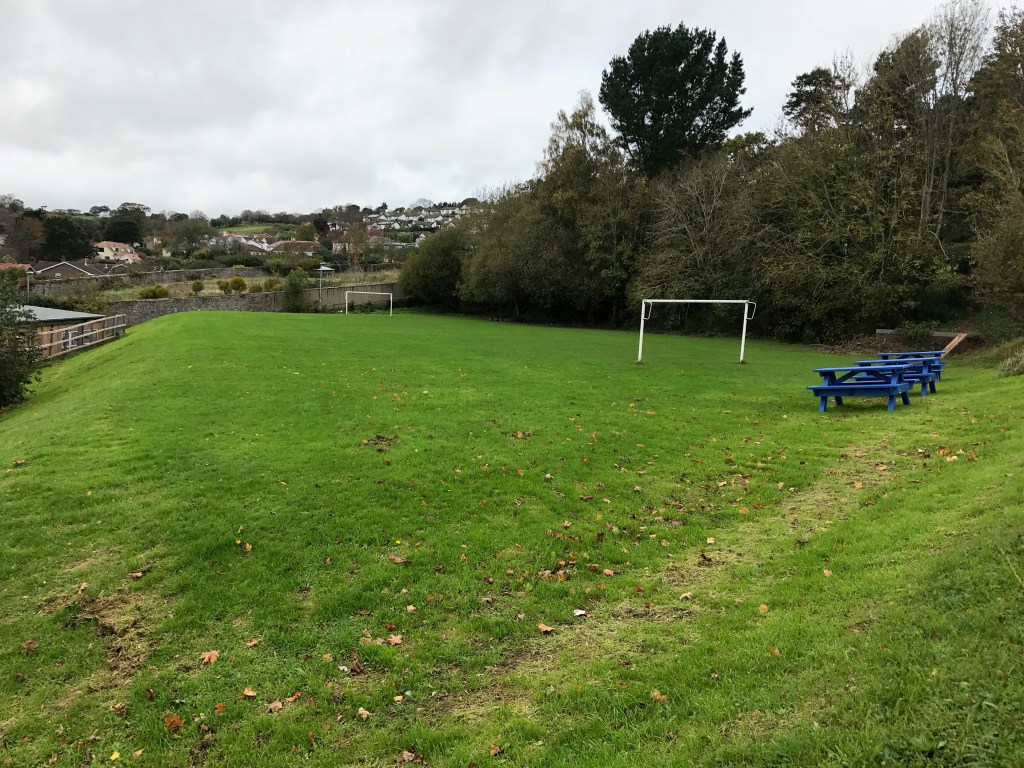
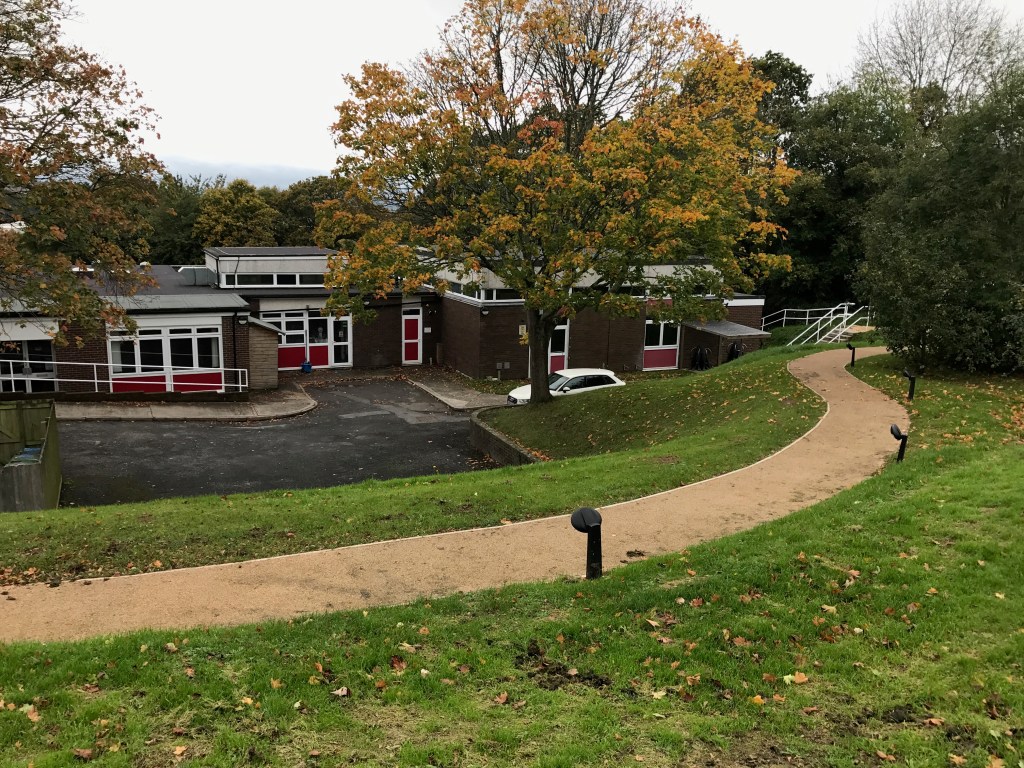
A recent image of the playing fields at Devonport High School
My first year at Devonport High School (where all first-year students were affectionately and more often than not less-than-affectionately known as ‘scruffs’) was arguably my most productive in terms of output and behaviour. I was keen to get on and experience what would be my first taste of prolonged stability in an educational establishment. I had planned to keep my head down as much as possible and try my best in all subjects and I more or less succeeded in this aim, save for a few ‘minor’ incidents. At the same time, this determination was coupled with a desire to avoid the treatment that I regularly saw meted out to other ‘scruffs’ in bustling corridors or less well-populated toilet cubicles.
I was quick to work out which subjects interested me. English (no surprises there), Biology, French, History and P.E. all produced varying degrees of success in that first year, but Chemistry, Physics, Latin, Maths, Geography, Music and Religious Studies were tedious and in some cases entirely unnecessary in my opinion. During that first year, we were ‘treated’ to an extra lesson, once a week, where we would read classic Greek tales aloud while overseen by the school headmaster, the hour-long experience imaginatively named ‘Headmaster’s lesson’. The head at DHS at the time, Mr. Peck, was a stern, upstanding citizen of a very definite type of moral fibre while not possessing a particularly puerile sense of humour (which he had no reason to, being an adult over the age of 50!) nor an understanding that most 11 and 12-year-old boys would inevitably find something amusing among the classics. Unfortunately, I would be the one to discover this absence of compassion.
I’ve always been a quick reader with the ability to skim ahead while taking in information as I’m going along. On this particular afternoon, early in my secondary school life, Mr Peck came gliding into the classroom, as was often his way, long, black robes trailing behind him, his silver hair following suit, catching the light of the early autumn sunshine that was shining in through the large ground-floor windows of C Block. Peck, whose quiet authority hid beneath fearsome eyebrows and an imposing stare, was not big on emotions and was clearly a believer in discipline being an effective form of communication and as such, interactions with him and instructions from him were often few and far between. A handful of us were convinced that he was a robot, put in place by the powers that be to cover up his entirely fictional classified death from perhaps a freak boating accident. But I digress.
Sadly, time prevents me from recalling exactly what we were reading aloud from, but I was already dreading my turn, not exactly brimming with confidence in my new environment, but as sure as eggs is eggs, as the saying goes, the finger of fate finally pointed in my direction.
I began to read, timidly, my voice laden with uncertainty, my eyes following the steady progress of my finger across the page while I also scanned what was to come. At this point, I feel it necessary to remind you that we were a class of 11-and-12-year-old boys, the reason for which will become apparent when I tell you that halfway down the page that I had recently begun reading from, the word ‘bosom’ leapt out at me. Next to me, on my right shoulder, Patrick Pollard, full of mischief and barely suppressed joy, had already clocked the impending embarrassment and mirth, attempting to hide his glee at what was inevitably going to descend into disaster. My heart sank to my stomach as Patrick, his mouth hidden behind his hand, began to excitedly whisper ‘bosom’ over and over again. By the time I reached the damn word, I had no chance, and ‘hilarity’ ensued as I lost what little control I possessed and began to giggle.
That giggle gradually descended into chaos and spread around the classroom like a Mexican wave as I tried repeatedly to complete the sentence. Carnage ensued as everyone took full advantage of the opportunity to misbehave on the watch of the most senior figure in the school and Mr Peck decided I was ultimately responsible for it. With tears now streaming down my face, struggling to contain hysterical laughter that I was powerless to hold back, I was sent on my way to wait outside Peck’s office for the subsequent bollocking, which in hindsight probably wasn’t much of a bollocking at all, but when you’re 12 years old and feel like a tiny fish in an enormous pond, things can often seem very different. And let’s face it, ‘I’m sorry, sir, I just found the word ‘bosom’ extremely funny,’ isn’t really much of a defence, is it?
While that should have been the end of it, a one-off, unfortunate mistake, the following week I was picked out to read again (first up at the start of the lesson and directed to read the exact same passage that had previously troubled me, which shouldn’t have been a surprise) and, seated next to Patrick once more, I discovered how exceptionally adept he was at whispering the word ‘bosom’ and remaining undiscovered as the perpetrator of my distraction and subsequent humour. I didn’t even get anywhere near the troublesome paragraph as I struggled from the off, thanks to my peer’s sly shenanigans and the almost electric air of anticipation inside the room. In years to come, I would liken these moments to the scene from the Life of Brian, where Pilate and the Centurion are discussing ‘Biggus Dickus’ and the guards are slowly losing their battle to contain their obvious mirth. This particular scene of mine would replay for a further two weeks before I finally managed to get to the end of the section I was reading without interruption and aching ribs, aided by the absence of one Patrick Pollard.
Physics was fun, said no one, ever. We had a teacher, Mr Gibson, who was absolutely off his trolley and terrifyingly unpredictable. If in later years he’d been arrested for mass murder, I wouldn’t have batted an eyelid. He clearly loved his chosen subject (well, you’d have to, wouldn’t you?) and would randomly become over-enthused about many of the finer points in and around the physics world while his hair would mirror the wildness in his eyes. In our first lesson, he decided in his wisdom that the ‘p’ in my surname was in fact a ‘b’ and called me ‘Hebburn’. I unwisely decided to correct him and he disputed my claim that I knew my own surname better than he did and subsequently spent weeks calling me by my newfound moniker and nurturing an unhealthy aversion to me. Until, that is, I took to calling him Mr Gibbon, at which point we undertook an uneasy truce. You get my name right and I’ll do the same for you, you strangely excitable madman.
The following year, in the same subject, I would inherit the giant of a man who was Mr Harrington, who would despise me in a similar manner while breathing coffee fumes over me and plotting my demise. Always dressed in a brown suit with a nose that would glow in varying shades of red and purple, we took an instant dislike to each other that would have two years to develop into a substantial loathing. My grasp of the finer points of Physics was feeble to say the least, but it always felt as though he would save the most difficult questions for me and then savour my struggle, feeding off my pathetic as I attempts to explain whatever it was that I clearly didn’t understand. If I asked for help, it was never forthcoming and eventually I just gave up. At the end of Year 3, I could hardly drop Physics fast enough.
Of the three sciences, Biology was the one that appealed most to me, but even that interest was sporadic. After that relatively successful first year, I discovered that I possessed an exceptional talent for not being able to keep my gob shut and pissing off teachers with uncanny ease. Some teachers were more patient and thick-skinned than others and on the odd occasion, my attempts at humour raised a smile and an eyebrow or two. Looking back, I think that was one of my biggest issues, the fact that I loved to make people laugh and if I thought of something ‘funny’ to say, it was more of a struggle not to let it escape from my cavernous maw. Essentially, I was probably a nightmare to teach and I think I can say with relative certainty that if ever my name was mentioned in the staff room, it would have been followed by the words ‘little’ and ‘shit’. I do regret my inability to apply myself in certain situations and I’m certainly anything but proud of how I behaved at school. I was by no means the worst, but I could have been so much better and maybe if I had been, it wouldn’t have taken me forever to work out what I wanted to do.
On reflection, and there has been a fair bit of that over time, I think that I was looking for positive interactions and by making people laugh, I was certainly getting that. The problem was that it was at the cost of my own education and reputation. I can remember hearing Geordie comedian Ross Noble, saying that if you thought of something funny to say but didn’t say it, it was the equivalent of committing a terrible crime. I imagine that I was subconsciously having that internal struggle without the social skills to determine when it was the right time to chip in with my observations and opinions. The surge of pleasure that I would get from making others laugh essentially outweighed any potential punishment.
Back on topic, Chemistry bored the living daylights out of me, despite the use of Bunsen burners and various chemicals. For three years, I ‘enjoyed’ a fractious relationship with Mr Sanders, a bespectacled disciplinarian with a neat combover, who didn’t suffer fools gladly. He was swift to mete out punishment to anyone who would misbehave and his favoured method of retribution was to demand the production of ‘two sides’ of lines upon the subject of one’s transgression by the start of the next lesson. The call of ‘two sides, four sides, double it, double it,’ was often heard during our lessons and even more often mimicked as we scurried away from the chemistry lab after the bell had signalled blissful release from our temporary incarceration. If the aforementioned ‘two sides’ weren’t produced by the villainous scum of 3S (if my memory hasn’t failed me), then the punishment would be doubled and demanded by the start of the next lesson and so on.
And so it went:
‘Hepburn, have you done your two sides?’
‘No, sir.’
‘Four sides, then. Double it, double it!’
I had no desire to ‘take on’ or beat the system and realistically, this should have been the point where I accepted my punishment, however unfair or ridiculous it might have felt at the time. For some reason, however, I made a different choice. Looking back, and knowing what I now know about parenting children and young adults with autism, I wonder if there was a degree of PDA around many of the choices I made (and in some cases deliberately avoided making) during my time at DHS. I’m not sure whether or not a diagnosis would have made a rat’s arse of a difference, but it was not something that was ever discussed.
The following week would once again see the tediously repetitive exchange take place once more, Mr Sanders slowly cranking up his levels of frustration and displeasure to the point where I thought he genuinely may have considered setting fire to my blazer while I was in it.
‘Hepburn, have you done your four sides?’
‘No, sir.’
‘Eight sides, then. Double it, double it!’
It took until the point where I reached 128 sides that were by now horrendously overdue, along with several threats of missing break times, lunch times and anything else that mattered to me, before the following exchange took place at the end of a lesson once everyone else had vacated the lab.
‘Hepburn, have you done your 128 sides?’
‘No, sir.’
A pause and a long, drawn-out sigh from Mr Sanders, who looked very much to me as though he was questioning many of his life choices. Primarily, teaching.
‘You’re not going to do them, are you?’
‘No, sir.’
‘Why not?’
‘Because I don’t want to, sir.’
Strangely, after that, we wordlessly agreed to a truce. I’d keep my mouth shut during Chemistry lessons and he’d leave me alone. I suspect that we were both relieved when my options came around and I chose Biology as my science.
I’ve been trying to collect my thoughts before moving on to the next part of my story. Walking through my early years has left me feeling bruised as I have uncovered more memories than I expected and reliving the times when I was on the receiving end of violence or worse has saddled me with a deep, cloying sadness that I am unable to shake off.
The thing about the physical violence is…after a while, it loses its shock. You can begin to see it coming, anticipate it. Recognise the signals. For me, it was always a reaction to something, so I learned to watch my father and to try to keep one step ahead of his anger. There were times when this worked and many others when it didn’t. Essentially, I was a child trying to learn adult strategies and implement them into my life. To this day, I still select where I sit in rooms with half an eye out for trouble on the horizon, giving myself both the best line of sight to anticipate any problems and the best chance of dealing with them.
Of course, I was by no means a saint and there were times when it could be argued that a ‘punishment’ of sorts was justified. Whether or not that punishment should have been physical is obviously up for debate and one particular occasion sticks in my mind to this day.
I must have been about seven years old, still attending Inverteign Junior School in Teignmouth, so we’d have still been living at Kingsway. I was no stranger to adult life; we were regularly exposed to bad language and sexual content, some of which, the swearing especially, was often a hot topic of conversation in the playground. During one of these conversations, it was suggested that if I wanted to make my father happy, which he obviously wasn’t during this time, I should share with him a particular phrase which he would find hilarious.
I was intrigued. Was this the much-sought-after magic solution that would lift me from those darkest of days? Could it ease my troubles and set me on the path to a ‘normal’ life?
Well, no, it couldn’t. Because unbeknownst to me, I was being totally and utterly set up and I bought it completely. As the school day came to an end, I merrily trotted through the gates and made the short walk home. As I reached the back door, I knocked and waited, butterflies in my stomach as I prepared to solve all of the problems in my tiny, pain-filled world. My Dad pulled open the door and looked at me.
‘Dad,’ says I. ‘I learned two new words at school today.’
‘Really?’ Came the reply. ‘What were they?’
I paused for maximum effect and braced myself to be showered with love and to be raised high upon his shoulders as some sort of saviour.
‘Fuck off!’ I proclaimed, proudly, and watched as his face turned slowly purple and the same fury that had led to the ‘cricket ball in the face’ and the ‘falling down the stairs’ incidents descended swiftly.
With my heart breaking, I made the seemingly wise yet ultimately futile decision to leg it. Down the steps, up the garden path that I had been well and truly led down, out of the gate and beyond. I would probably have been better served by taking my punishment there and then. Instead, he was left with time to stew on my misdemeanour. When I finally returned home after about three hours of freedom, I was dragged up the stairs, given a hiding and had my face shoved in a sink full of water while my father shoved half a bar of Palmolive in and out of my mouth. And the worst part of all of that? I still had no idea what I’d done wrong.
I know that it was ‘the way of things’ back then. But what exactly did it teach me?
I think it taught me that I couldn’t trust anyone. It taught me that soap doesn’t taste very nice, either when it’s being forced down your throat or when it’s on the way back up afterwards. It left me bewildered and confused. I was told this was a good thing, but it clearly wasn’t and in amongst the shouting and the hitting, there was no explanation. So I had to draw my own conclusions and more through luck than anything, I resolved to stay away from the phrase ‘fuck off’ for a considerable amount of time.
What was beyond my father at that time was the ability or perhaps the inclination to educate me. Would it have been more effective to sit me down and discuss what I had done and why I shouldn’t have done it? I don’t think that I was unreasonable as a child and I honestly believe that I would have responded far better to reason than I ever did to his more ‘traditional methods’.
On reflection, however, at least I knew where I stood with the violence. It was straightforward, even if I didn’t always understand why I was taking a pummelling. It was obviously because I’d done something wrong, I just had to work out what that was and not do it again.
The other stuff was far more confusing because it wasn’t so easy to anticipate and sometimes it came from nowhere. Or worse, it came out of love. Or what we thought was love back then and let’s be honest, it wasn’t like we were inundated with good role models in our family.
I think that I must have spent a large part of my childhood silently raging at the injustice of my world. I was always a thinker and, I suspect, always a worrier, but I worked out very early on that there was something very wrong about the way that I was being parented and that if I ever got the opportunity to be a father myself, I would never repeat those mistakes. Of course, I say that I was silently raging because there was no benefit to voicing my anger and my frustration, as it would only provoke the inevitable reaction. I wonder if that’s why I’m vociferous against perceived injustice these days, having been so quiet for so long; it’s quite the revelation when you finally learn to make a stand. And I can still remember the day that I made a stand against my father and strangely enough, I’m reasonably sure that it was around the time that I became a father myself. Twenty-six years ago.
We were visiting my Dad and Brenda at their house in Plymouth and he was trying to wind me up to get a reaction from me. I think we were watching something on television that I was interested in, but he wasn’t and he kept prodding and poking my leg. Small-time stuff, but it was really irritating. Eventually, I got to my feet and stood over him.
‘If you do that again, I’ll fucking lay you out!’ I said, having to check that it was my voice saying those words. I braced myself, suddenly seven years old again and waited for his response. He tried to make light of it, saying that he was just messing about, but the Universe shifted in that moment and I would never be made to feel the way I did when I was a child again. I had made my stand and that was enough. If only it were that easy to exorcise the ghosts of my childhood.
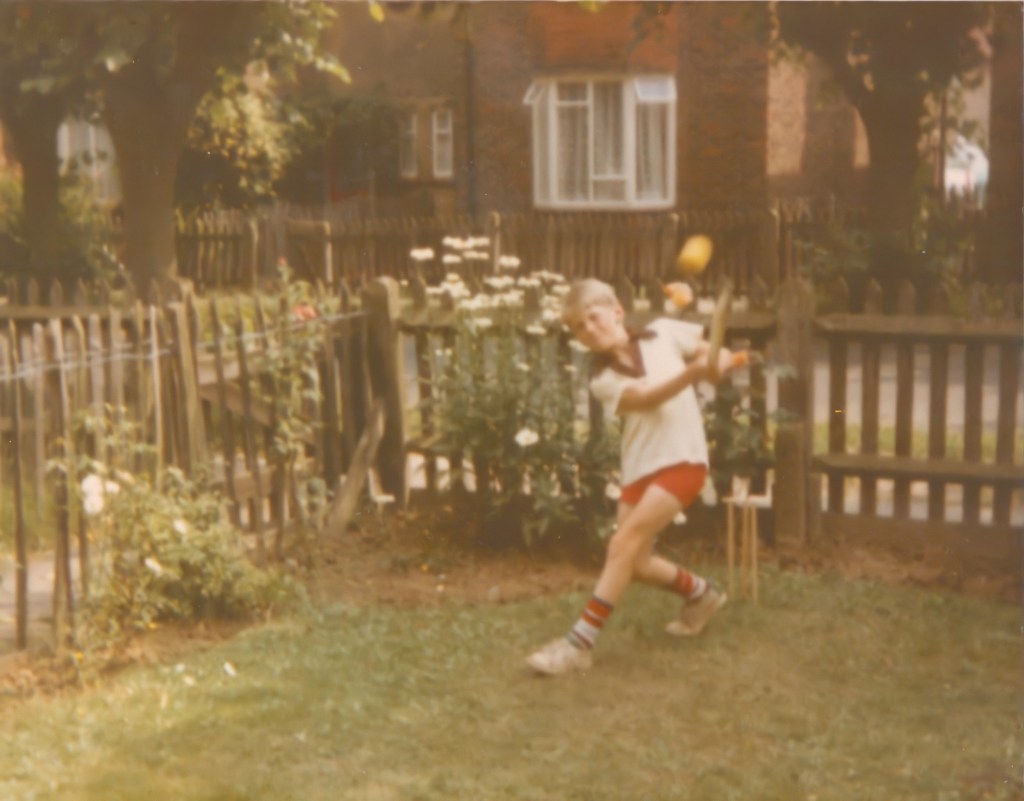
At a guess, eight-year-old me as a right-handed slogger.
For as long as I can remember, cricket has been a massive part of my life. Watching, playing and finally moving into coaching the game has presented me with many memorable opportunities that I look back on with fondness, pride and occasionally, a little regret. And now, as my cricketing journey begins to come to an end, I find myself reasonably content with my lot. There were more good days than bad, which I suppose must count for something.
The infamous Test at Headingley in 1981 was the first ‘jumping on point’ that I remember, although prior to that, my love affair with cricket was very nearly ended before it had properly begun. In our tiny back garden in Teignmouth (I would hazard a guess that it was barely ten yards in length), we would occasionally have small, family games. The only one that sticks in my mind, however, is the one where I received a frightful injury at the hands of my father.
Picture the scene, a short, rectangular garden with a shabby lawn on the right and an uneven concrete path running down the centre as the wicket. Three steps doubling up as ‘stumps’ at the end of the path (down the slope, a little like Lords!) leading up to the garish, yellow, back door and a coal bunker at short fine leg. A tricky deck to bat on, no doubt and dad was first up, a not unusual occurrence. I bowled the ball, in all likelihood with a suspect action at the age of maybe seven, proper cricket ball mind, no tennis balls allowed. The ball hit a crack in the path at no great speed but jagged off at an angle into my father’s shin. Did it hurt enough to warrant what followed? I doubt it, but as was often the case at 178 Kingsway, reason and logical thought scurried for cover and shepherded in rage and fury as their substitutes.
The minute that the ball had hit Dad, I knew I was in trouble. That was the way of things. I apologised immediately, aware of the futility of my protestations as he hopped around the garden as though Dennis Lillee had just snuck a vicious inswinger through the gate and caught him on the crease minus pads.
Eventually, the dust settled, Dad’s face resolute, his jaw set sternly as he pointed the bat at me.
‘Come and stand here,’ he said, indicating a position that even silly mid-off would baulk at. Suicidal mid-off more like.
I shook my head, butterflies blooming in my stomach and the palms of my hands beginning to sweat. He ordered me into position again and once more I refused. One more demand and I was left in no doubt what my punishment would be if I refused. My three older sisters watched on in silence, perhaps grateful that they hadn’t suffered the misfortune cast upon me by the crack in the path. I shuffled slowly to the spot that he had indicated, my feet like lead and tears pricking at my eyes. He threw the ball to one of my sisters, I couldn’t tell you which one and told her to bowl the ball.
You probably know what’s coming. I thought I did, but for whatever reason, I don’t think that what happened next was what my father had planned. Even now, I feel like I’m making excuses for it, trying to make it seem that it wasn’t that bad. But it was. What fills a grown man with the need to hurt his own child after he has been accidentally hurt by them still escapes and haunts me in equal measure to this day. He did have a difficult life and upbringing, and his actions were often a consequence of what he suffered as a child. But there is always a choice, isn’t there?
The ball was bowled slowly and I watched as my dad raised his bat to strike the ball. I tell myself that his intention was merely to replicate the injury that I had inflicted upon him, that maybe the ball hit the same crack in the path that mine had and caused him to hit it differently. The ball thumped into the middle of his bat and ricocheted off into my face, smashing into my nose and right eye socket.
Cue an intense, searing pain, the seeing of stars and the pouring of blood as I fell to the floor. I have no memory of anything immediately after the impact but I’m told that I couldn’t see out of my right eye for a couple of weeks and that the swelling and bruising was what they termed as ‘severe’ even back in the late seventies when nothing hurt anyone by all accounts and life was ‘so much better’.
So, realistically, I shouldn’t love this daft, old game that can see five days of play with no winner. The sport where you can take part, do nothing or worse, do something and fail abysmally yet still come back the following week for more. It’s a game where one will fail far more than they will succeed, but the highs, those ruddy glorious days where fortune favours the brave, the edges race to the boundary and the one-handed, diving catches stick make every bad umpiring decision, every mistake and every soggy afternoon sheltering from the elements worth it. I can’t explain why. I just find it’s best to believe it.
Well, then. We’re now into what was Chapter Two of the book before it became a blog. So far, so good.
Now we come to one of the things that I’m most afraid to share. So, why share it on a public blog, you may well ask? Justifiably too, because I’m not sure that I can give you an answer. Perhaps it’s because I’ve committed to telling my story that I feel it should be an honest account of who I am. Warts and all, so to speak. And I’m certainly stubborn enough to stick to it if that is the reason. Perhaps, in trying to make sense of who I am and where I’ve been…perhaps I’m hoping that you might do a better job of making sense of it than I am or have done. Allow me to ask a favour before you read any further, though. Please tread gently.
If you’ve read this far on my blog, you’ll be well aware that there were numerous incidents in my childhood where I was on the receiving end of some particularly unpleasant, violent abuse. I don’t really like to call it that, but let’s be honest, it’s what it was. My father also suffered horrendous abuse as a child, far worse than anything that I went through, but that shouldn’t diminish the impact of the events that took place. The ones that I’ve shared so far. What I will say is that, for all of his faults, what I’m about to share had nothing to do with my father. Not the other stuff. I have long since accepted that there are many things that I will never uncover about my childhood. Too many people are missing and too many rivers have flowed under far too many bridges. And I have blotted many things from my memory. Some things really are best left alone.
The problem with reflecting on one’s life and digging for memories is that it can unearth some truths that were not meant to be remembered. We’re encouraged to talk these days, aren’t we? Some of these truths were unearthed a long time ago, yet they were impossible to resolve. Even less chance of that happening now, but…this comes back to me wanting to understand why people do the things they do. There are memories that I am still discovering to this very day, some of which I have never shared with anyone.
And now I have a choice to make. How exactly do I share this? I’m not going to give many details; I don’t feel it’s necessary. I’m pretty sure that everyone can paint their own pictures.
There were times during my childhood, numerous occasions, where the abuse was not just violent. As I said earlier, I’m not sharing details, not because I don’t remember what happened. Much of it is as clear now as it was back then. I just don’t think it’s necessary. Some of these incidents are also as confusing now as they were all those years ago. Some of them are not. Some of them are easier to understand, some are painful and shameful. Some people should have known better. Some, arguably, did not. I also know that I am not the only one in my family to have gone through this. It doesn’t make it any easier, but it definitely makes it worse.
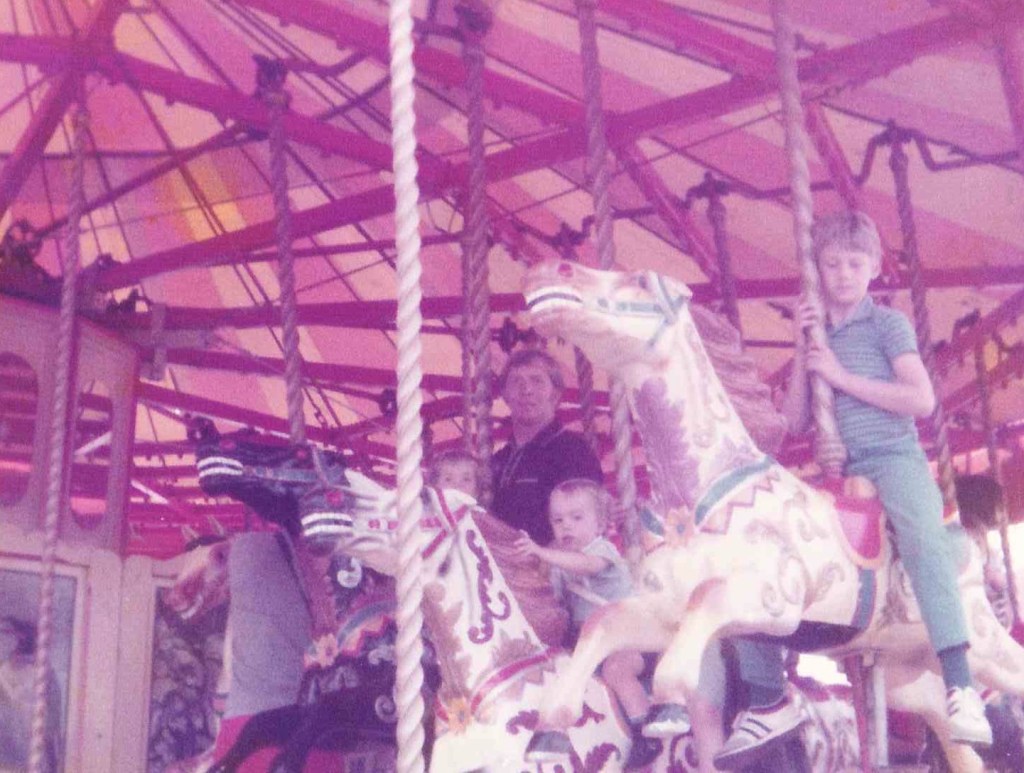
On a fairground ride during a holiday in Selsey. My stepfather is in the background.
Here’s the thing. When you are starved of affection, you can believe that any sort of attention is good. When you are vulnerable, when you believe that you are nothing or nobody…when someone ‘sees’ you or makes you feel something, anything, then you’re already at risk. Reading that back, it sounds a bit like I’m victim-blaming myself, except I don’t think of myself as a victim. I try to avoid doing that.
As a child, you are taught to respect your elders. Respect adults. I appreciate that we’ve moved on from the likes of ‘speak when you’re spoken to, ’ and when I say that I appreciate that, it’s because a large part of my early years were lived under that exact mantra. Or perhaps ‘do as I say, not as I do’ would be nearer the truth. Adults are supposed to be…our protectors? Our teachers, our guiding lights. But what happens when they are not?
When I consider the things that happened to me, I suspect that I’ve just picked at the scab. It’s still there and it hurts. I’m afraid to look at it, it makes me feel…sad and ashamed. And I don’t know for sure what’s beneath it. I don’t want to remember, which I suppose is new territory for me. Some things that happened were ‘low level’, I suppose. Some things were less so.
And suddenly, I begin to understand why I find social situations difficult, why I struggle to maintain friendships and relationships. My trust is easily won because I want to think the best of people, but it is also easily lost. I am defensive and prickly and I will stand up for what I believe in. Not because I think it makes me a better person. Not to impress anyone. Not to be awkward. But because I refuse to let anyone make me feel as though I only deserve the worst that life has to offer.
I refuse to let anyone make me feel the way that some people did when I was a child. Unimportant. Lonely. Insignificant. Abandoned. Unloved.
In my fifty-odd years on this globe, I have overcome a destructive, jealous streak. I have loved and I have lost, many times. I have hurt and let down those dear to me. I have made so many mistakes. I have self-harmed and I have contemplated ending my life. I have been kicked when down, been hurt more than I thought was possible and I’ve been betrayed by people whom I thought I could trust, time and time again.
So if I am combative, brusque, opinionated and forthright, it’s because of all of those things. If I can’t quite hide my disappointment or my sadness at the way that events transpire, it’s because of all those things.
If I am distant and I hide away…if I think that people don’t like me. It’s because of all those things and more. I am complicated. I am hurting, still. I am ashamed because I don’t feel as though I deserve to feel pride or happiness. I feel underappreciated, I feel unseen. I feel alone. I am 52 and I am eight. I am moving forward one day at a time, yet I am trapped in the prison of my past. I am nothing, I am nobody. I am afraid.
The football pitch at Bishopsteignton Primary School.
Football at Bishopsteignton was a big thing for me. I suppose that I was a bit unusual in that I could use both feet, so would often be employed at left-back in the absence of anyone else who was genuinely left-footed. I was stronger with my right, but was comfortable enough with the ball at my feet to not need to just use the one foot. We took part in a number of six-a-side tournaments, winning a couple and I think I’ve still got one of my medals somewhere among the multitutde of boxes of paraphernalia that I’ve collected over the years. We had a decent team, with Christian Cook in goal, I think Justin Bannister in defence and Cameron Groves in midfield/attack. From memory, Cameron was a very talented young player but sadly, I have no idea what happened to any of my teammates after I left.
I’ve never been very good at keeping in touch with people, something I’m told that nowadays suggests that I have issues with object permanence, a more concise way of saying ‘out of sight, out of mind’. This has continued to plague me throughout my adult life. I’m quite a solitary person and it doesn’t take much for me to convince myself that if I don’t hear from people, they probably aren’t that interested in spending time with me or communicating with me anyway – I mean, I’m me, so why would anyone want to socialise with me and my associated issues (horrendous overthinking and social awkwardness while keeping a constant vigil anticipating the next sign of trouble). Even though I know it’s illogical, it’s so deeply rooted inside me that it’s one of the few habits/issues that I’ve really struggled to overcome. It could easily be solved by just messaging friends, couldn’t it? Even more so in this day and age, but when you’re convinced that you’re not worthy or even likeable, it’s a very slippery slope to attempt to surmount. I suppose in some ways that it’s partly tied up to that loneliness I felt during those long evenings in pub gardens or any number of similar incidents that I experienced as a child and I find it difficult to talk about because I feel that it makes me appear needy or as though I’m searching for attention. Nothing could be further from the truth. But once again, I digress. Back to the football.
There was one game that stands out in my memory, a home game up on the pitch that sat atop quite a steep hill, which made it ‘fun’ when the ball got kicked out of play on one side of the field. During the game in question, we were attacking but I was hanging back on the halfway line when the ball was cleared up field in my direction. I waited patiently as half a dozen or so boys ran en masse towards me, bunched together as was often the case in primary school football. As the ball dropped, I swung my right foot at it, lashing it skywards more out of hope than anything else and watched in stunned silence as it arced up and away, clearing the opposing goalkeeper and sailing into the net. I didn’t score too many goals in my time, but that was probably the most memorable.
There was another game where we were battering the opposition and we won a corner on the left. I’d been told that I was on corner duty, so I swung the ball into the middle of the penalty area and stood watching the melee that followed until one of our players scrambled the ball over the line. The whistle blew, which at first I thought was to indicate that a goal had been awarded, but our teacher and referee, Mr Dunn, with his tufts of fluffy, white hair sat either side of a bald patch the size of Bulgaria (I offer my humblest apologies if my memories of Mr Dunn’s appearance are misplaced, it’s been an awfully long time and so much has happened), instead chose to give offside against me as I hadn’t moved from the spot from which I had delivered the cross and by the letter of the law back then, I was offside, despite the fact that I could hardly be deemed to be interfering with play from where I stood. I wonder if the game had been a tighter affair whether or not he would have made the same decision.
Around the time of that game, along with Christian and Cameron, I was invited to play for the county side. I was reliant on a lift but we got delayed on the way and when I arrived at the game we were already losing and it was approaching half-time. I had little time to warm up and prepare before being thrown into the fray and while I didn’t have a bad game, I obviously didn’t do enough to warrant being selected again. Had I not turned up late and been able to prepare properly things may have been different, but ultimately I was never much more than a useful player, certainly not a standout, but I loved the game and that was good enough for me.
We did make it to a couple of county cup finals and I remember the morning of one game where I had spent the previous night throwing my guts up with a raging temperature. I was never allowed days off school, but even if it had been on offer, I wouldn’t have missed the final for anything. I somehow dragged my body off my sick bed and played three quarters of the game before being subbed and promptly vomiting at the side of the pitch. We lost 4-2 and I was absolutely gutted when I was told by the teacher that I shouldn’t have played because I was sick. It was the only time that I was ever disappointed in Mr Dunn but on reflection I suspect he was as disheartened by the defeat as we all were. I think it also reflected my own frustration as I felt that I had let him down.
My time at Bishopsteignton came to an end around eight months before I was due to head off to secondary school, I think. By this time, Dad, who was back in work at a nursing home in Newton Abbot, had started seeing Brenda, who would go on to be his second wife. Things were changing at home and a far bigger shift to our circumstances was on the horizon. I think that he was offered a job in Plymouth by an old friend of his, Alex Campbell, so we packed up our belongings and we said goodbye to the village of Ideford (even writing about it now makes me feel sad). One thing that didn’t properly register until many years later was that we left Korky behind with our former neighbours. She was in her twilight years by then and the new flat that we were moving to didn’t allow pets. I hope that she was happy during the remainder of her life and that she managed to avoid particularly woolly and hazardous jumpers.
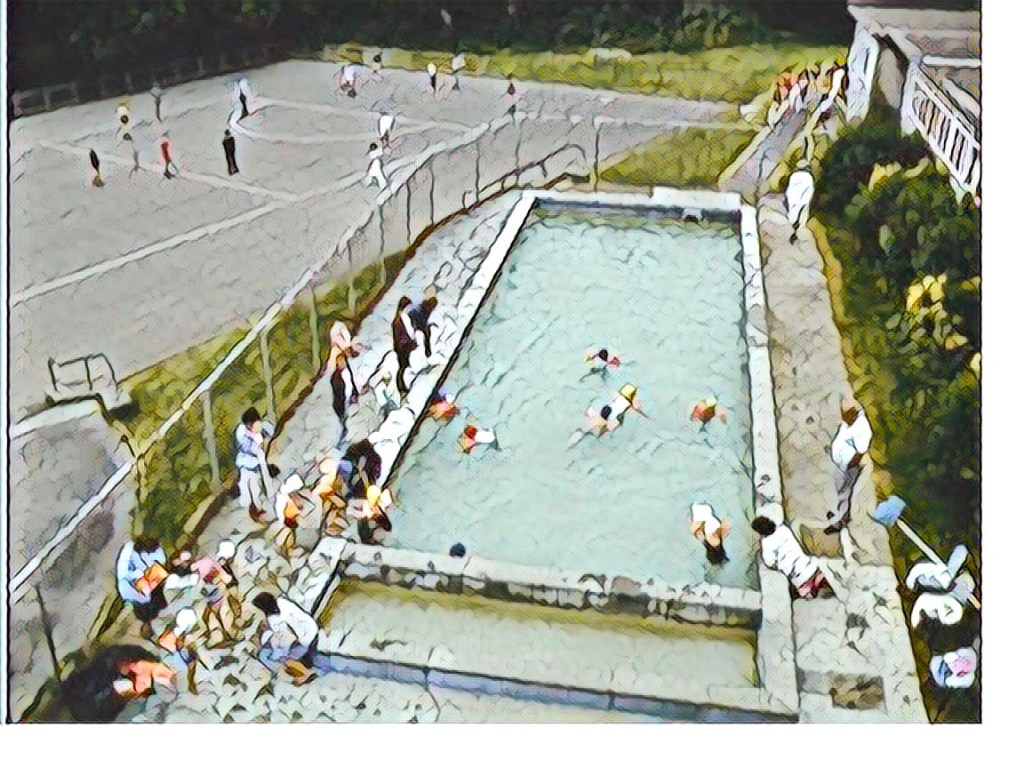
My new school, Pennycross Primary School seemed nice, although it took me some time to settle in. It was here that I finally learned how to swim, by no means an easy task given my previous troubles in water, but with the aid of several floats and an understanding teacher, I somehow managed to complete 25 metres of the school pool, crawling along with the equivalent of an aqua Zimmer frame and not a little humiliation before finally managing to progress to 50 metres without the need of flotation devices.
The pool at Pennycross Primary School.
I went straight into the school football team upon my arrival and in my first game I managed to score a spectacular own goal, putting in a full-length slide in a watery puddle to intercept a through ball only to divert it past my own goalkeeper and watch in horror as it trickled over the line, sodden shorts riding up my arse crack to complete the somewhat pathetic scenario.
Following my move to the new school I took and passed my 11 plus, which gained me a place at Devonport High School for Boys, news which thrilled my dad far more than it did me. Having already studied at four schools by this time, the prospect of another ‘fresh start’ wasn’t really doing much for me.
After a couple of months in a flat at Mount Gould, we moved into a house opposite Pennycross Primary in Springfield Crescent – adjacent to the place where dad would be working, a home for mentally handicapped children that the kids in my year at school had ‘affectionately’ and horrifically nicknamed ‘The Mongol Mansion’. The house was nice enough and the big green opposite was useful for games of football and cricket. It was also a relief to be living so close to school after the endless bus journeys to and from Ideford. It took some adjusting to living in a city and once again having to try and form new friendships.
By far my most exciting discovery at Pennycross, was the fact that there were girls at the school and some who were occasionally mildly amused by my irresponsible and immature shenanigans. Neither did they seem to find me as repulsive as I thought I must be, which opened up a vast and daunting landscape to traverse. There was one girl in particular who I took a shine to, Joanne Kenny (time has dimmed my faculties in the last 41 years, the Joanne may have been missing an ‘e’ and her surname may have been Kelly but I’ve gone with what my instincts tell me is correct). In my mind’s eye, she was slim and of a similar height to me with long, brown hair and an intelligence that burned fiercely behind keen eyes. I feel reasonably safe in the assumption that she probably remembers little to nothing of these events, but they stuck with me because again, I look back disappointed in the way that things transpired. I think we had arranged a date, which for two eleven-year-olds back in 1985 probably involved going into Plymouth City Centre and generally mooching about the place. To say that I was inexperienced in such matters would be a huge understatement, but nevertheless, I was excited by the prospect of taking a real, live girl out for the first time.
Before the prearranged date took place, however, fate intervened, in the shape of one of my few friends at my new school. I’m not going to name him, but he took me to one side to share some ‘important information’ with me ahead of my keenly-anticipated rendezvous with Joanne. He told me, in the strictest confidence of course, that Joanne had epilepsy (foreshadowing one of my darkest days in the future). Despite being the child of parents who worked as nurses, I had no idea what this was or how it presented, so my friend kindly gave me the details as best as he knew them, asking if I’d considered what would happen if she had a fit while we were out together, which might lead to serious injury or worse, death. Obviously, I hadn’t and my normally loquacious self was stunned into ponderous silence. If I’d possessed even half a brain cell back then, I would have asked Joanne about it, but in my perceived wisdom, coupled with a resurgence of crippling self-doubt, I decided that it would be rude and disrespectful to seek such information and by far the best way of dealing with any potential danger or discomfort for either myself or Joanne, was to simply not turn up to the date.
I can almost hear you, dear reader, calling me a prize twat as you take this in. I think it myself. Joanne was inevitably furious and it was only after a robust exchange of views, mainly hers, that I realised quite how badly I had fucked up. There I was, socially awkward, lonely and misunderstood for much of my life and the first time that someone had given any inclination that they might like me, I’d acted like a complete knob. In fact, I’m not even sure that Joanne did have epilepsy and somewhere deep in the furthest, most repressed corners of my memory, something lurks to say that she didn’t and that my friend had advised me so readily because he was also carrying a torch for her. In the grand scheme of things, these fledgling flutterings of romance likely amounted to nothing other than a distant memory for me, who spends far too much time recalling such events and a random story told in a book that the other two protagonists will probably never read anyway. Which probably sums up my life in a very complicated and misshapen nutshell.
Aside from the previous incidents, I remember so little of my time at Pennycross, save for a rather strict teacher named Mr Barrett, whose wrath I recall incurring at some point, probably due to my inability to keep my cavernous gob shut. What didn’t help, was that Mr Barrett looked a little like the American actor, Geoffrey Lewis, who played Mike Ryerson in the 1979 miniseries of Stephen King’s Salem’s Lot, which I saw on first broadcast in the UK in 1981 (I think!). It terrified the shit out of me but instilled in me an absolute love and fascination with horror.
The actor, Geoffrey Lewis, as Mike Ryerson from Stephen King’s Salem’s Lot.
A few months later, I saw Mr Barrett on a bus into Plymouth city centre and we had a conversation that changed my opinion of him. It’s so easy to just see teachers as professionals in education and I wish that I’d thought more about this during my schooldays. I would imagine that I was probably quite difficult to teach and my time at Devonport High School did little to dissuade me of that notion even to this day. I was by no means the worst behaved in any class but I had developed a simple approach to each subject that I studied. If it interested me, I would work hard and if it didn’t, then frankly I couldn’t be arsed. Sadly, I didn’t possess the skills to keep a low profile and do what was necessary to avoid getting into trouble. I was easily bored and loved to make people laugh, so whenever the opportunity arose to entertain my peers, I generally seized it.
Sometimes I would get away with it and teachers would be momentarily amused and other times my mouth and glib sense of humour would bag me a detention or two. Looking back, I could and should have done more and worked harder, although I’m not convinced that I would have ended up anywhere else other than where I am now. Ultimately, I think that I was always supposed to either end up in sport or become a writer and I believe that I’m fortunate to have found myself with the opportunity to dabble in both areas! Whether or not I’ve been successful is for others to judge, but both career paths have given me moments of happiness. For someone who is not blessed with confidence or self-belief, that’s generally as good as it gets! However, now that my time in cricket has come to an end, I look back with mixed emotions, hoping that in time the good memories will outweigh the bad. If nothing else, that time has given me more stories to tell.
School days, we are often told, are the happiest days of our lives. I hope you’ll forgive me if I disagree!
Primary school, to me, was an endless stream of navigating mini-popularity contests while trying to work out what the fuck was going on with myself and the world in general, a harsh lesson on the fallibility of human nature and the innate tendency in a percentage of the population to attempt to impose their opinions and restrictions upon others. I wouldn’t say that I was ever one of the popular kids, always worried about being wrong so I would never raise my hand to answer a question in class, which probably said more about the fact that I was continually led to believe that I was either stupid or worthless than it did about any actual ability that I may have possessed. Break times were generally spent playing football and avoiding anyone who looked like they might be trouble. The constant threat of being on the receiving end of an unprompted wallop refining my instincts to spot any potential issues from several miles away to an almost supernatural level.
My memories of Inverteign Junior School, scene of my first foray into the education system, are more than a little hazy. I have vague recollections of a girl called Emma, who came round to Kingsway after school one afternoon, where we spent a good half an hour sliding down the back of the sofa onto the cushions below and laughing uncontrollably at the fact that we were being allowed to do so – normally any such behaviour would have elicited a hefty clip around the ear (for me, obviously, not my guest). By all accounts, I often cut a forlorn figure in the playground, avoiding crowds and instead preferring to sit by a flight of steps, watching all of the drama unfold before me while wishing that I was somewhere else. I remember nothing of the lessons, but one lunch time, while standing in the dinner line, a girl called Sarah, who had short hair and a round face, pushed me out of the way and took my place in the queue. I pushed her back and thought nothing of it until I felt myself lifted off my feet by the collar of my shirt and found myself levitating backwards, zooming further and further away from my much-needed lunch and down corridors towards the headmaster’s office. However minor my misdemeanour had been, I had made the fatal mistake of transgressing in full view of Mr Last, the aforementioned headmaster, who might not have ruled with an iron fist, but pretty close to it. In my memory, he looked like a younger, slimmer Ricky Tomlinson but was far less avuncular than the popular Scouse actor.
Once in the office, I was deposited upon the floor and told to stand in silence as he looked me up and down with an icy stare. He pulled open the drawer of his desk and took out the cane, laying it carefully and precisely down on the desk in front of him. No stranger to pain or violence by now, my stomach lurched in an all-too familiar way and tears sprang to my eyes. I knew better than to protest my innocence, it was pointless.
Whether or not Mr Last took pity on me I’ll never know. Perhaps he knew of my situation at home, my older sisters were or had been in attendance at the school. Or maybe the stars just aligned in my favour for once. But whatever the reason, I escaped physical punishment by the skin of my teeth. I was, however, left in no doubt as to what would happen if I were to behave in such a manner again, especially towards a girl.
Thinking back now, that must have confused me. We’re taught that physical aggression is wrong and that violence towards women and girls is rightly unacceptable. So how did that square with what I witnessed at home? For clarification, I’m not excusing what I did and it was totally right that I got pulled up on it and neither am I suggesting that aggression towards women or girls is acceptable in any situation. Perhaps confused is the wrong word because I knew that my father’s behaviour was unacceptable. Anyway, it was a harsh lesson, but an entirely necessary one, especially given what I would regularly witness or be on the receiving end of.
Our move to Ideford would see me leave Inverteign and head to Bishopsteignton, which sounds not unlike the title of a new Sunday night period drama on the BBC. By this point, I had already had a short spell at Colgate Primary School after Mum’s initial aborted attempt at leaving the family home and I wonder if chopping and changing schools at this point in my life made it difficult for me to establish and maintain friendships, something that I’ve always struggled with.
At Bishopsteignton, things were arguably much smoother than they had been previously, although the long bus journey to and from school meant that I was having to get up even earlier, tricky during the summer months after evenings in the pub garden and the subsequent late-night conversations.
My memories of the actual school itself are patchy, vague recollections of queueing for thin and watery semolina with a blob of strawberry jam floating in the centre swim among half-remembered conversations and the occasional misdemeanour. What I do remember is that I had an affinity with books and was good at spelling, while plenty of time on my own nurtured my love of writing stories.
P.E. was generally fun, although I remember one ‘gym’ session where we had to vault over the long ‘horse’. I’m sure those of you of a certain age will remember it, it was always put out ‘lengthways’ and would essentially lead to young boys attempting to clear it with a jump off a badly placed springboard and more often than not end with them squashing their knackers as they landed with a thump on the padded top.
The vault, my nemesis at Bishopsteignton
There I was in my ill-fitting kit and black pumps (which, believe me, was a blessing in those days as the punishment for forgetting one’s P.E. kit was to do the lesson in one’s pants – boy or girl, they didn’t tend to discriminate when shaming kids), staring nervously at the springboard and the seemingly enormous obstacle in front of me. I’d previously struggled to get anywhere near the end of the horse, let alone completely over it. On this occasion, filled with a mixture of fear, hope and resignation, I charged off towards the springboard and timed my jump perfectly, riding a wave of elation as I soared into the air like a scrawny eagle, almost clearing the vault. Almost. I caught my arse parts on the back end of it and felt an intense stab of pain shoot up my cheeks and spine before landing flat on my face on the floor beyond, unable to do anything but roll around and wail in agony for a good two minutes. Eventually, I was helped up and guided towards the school office, my face streaked with tears and what little dignity I retained shattered into tiny pieces.
Dignity at primary school is, in my opinion, highly overrated. School discos were the perfect environment to suffer both shame and embarrassment. I’ve never been a dancer but have always been reasonably happy with my lack of rhythm and co-ordination, settling instead for looking ‘thoughtful and sophisticated’ while cradling a pint on the outskirts of the dance floor. I love the thought of dancing, of being able to express oneself with finely timed and co-ordinated movements but I just can’t do it and am convinced, probably with good reason, that any time I attempt to move around in time to music that I look like a poorly co-ordinated twat suffering random body cramps.
But once, in my innocence and naivety, I decided to give it my best shot. I couldn’t tell you for one minute what I was wearing to the aforementioned disco, but aside from a time that I will come to later, I’ve never really been blessed with sartorial elegance and neither were we particularly well off as a family. In all honesty, I was probably still in my school uniform, but with Adam and the Ants blasting out of the DJ’s speakers I was enthused enough by the rhythm of Goody Two Shoes to ‘throw some shapes’ if I may be permitted to use the slightly more modern vernacular. Quite what those shapes were is anybody’s guess, but I suspect that they were being thrown along with a healthy dose of undiagnosed autism and probably appeared more than a little camp. Undaunted by my lack of skill and rhythmical co-ordination, I continued to whirl about like a boy possessed, who had just been plugged into the mains, careering into two nearby teachers and catching two plastic cups full of squash with my flailing arms, sending them soaring into a nearby crowd of girls who were shuffling about in a far less enthusiastic but ultimately more graceful and attractive manner than I had been managing. Soggy screams cut across Adam Ant and his ponderings about exactly what we did if we didn’t drink or smoke and once again I found myself dragged from the scene of the crime, my shoes sliding forlornly through the trail of spilled squash and my dancing career entering a pretty permanent hiatus.
One other thing that I discovered at Bishopsteignton was that I had a natural propensity for finding trouble. There comes a time in the life of every primary school child where they make that wonderful discovery that their teachers are real people and as such, have real names. Those of us who are or were deficient in the social skills that seem to come so readily to the ‘confident, symmetrical geniuses’ that all classes have would inevitably come a cropper when making this discovery. Whether that be falling out of reality upon seeing a teacher out of their natural environment and doing something mundane like the weekly shop and being unable to complete a coherent…whatever or worse. And I’m sure that you can guess that I inadvertently took the path marked ‘Here be Dragons’.
We’ve all had those horror moments in class, haven’t we? You know the ones I mean, when you accidentally call your teacher Mum or Dad or a variation thereof. We had a new teacher arrive at the school, Mr Glenny, who took over the football team from lovely, but elderly, Mr Dunn as well as some of his classes. One morning, after being entrusted with returning the register to the school office after registration, I handed over the manilla folder, which in my head contained top secret documents, as one of the office staff was talking to the aforementioned suavely attired Mr Glenny, with his immaculately coiffured side-parting and his softly spoken voice.
‘Morning, Dave,’ said she, full of the joys of spring and perhaps with a slightly flirtatious tone in her voice. That last part might be completely untrue, but it reads a little better and all good stories need a love interest.
I gimbled in fascination at the discovery of my teacher’s first name. This was incredible. This was bigger than finding The Ark of the Covenant, more wondrous than the treasure of Sierra Madre and second only to finding white dog poo in the playground. I was Indiana Jones without the whip and fetching hat. I was suddenly in possession of information that might make me cool.
Cool has always been overrated and ultimately unattainable in my book, but in that moment this previously unheard knowledge made me king of the school. I strutted back to the classroom, if such a thing is possible at the age of ten, down corridors that glistened in glorious sunshine and I’m pretty certain that somewhere a crowd roared in celebration at the gladiator’s return. This was A MOMENT! A moment not to be wasted. Of course, that information was eager to escape from my tightly pursed lips, keen to be set free to be whispered in cloakrooms and giggled at beneath the basketball posts. But this wasn’t just a moment, this was MY moment, so the timing had to be perfect. Somehow, I held on to this forbidden gem until that afternoon, I navigated the treacherous territory of break and lunch time to get to the afternoon lesson.
Homework had been submitted a couple of days previously and as was the case when it had been marked we were called up to the front of the class to collect our books. I sat in silence as those with surnames beginning with the letters A-G were called up ahead of me, a confident smirk upon my lips, content that I was about to wow everyone with my secret intelligence on the relatively new teacher…
‘Groves…’ My friend, Cameron, trotted obediently to Mr Glenny’s desk to collect his book before turning on his heel with a quiet ‘thank you, Mr Glenny’ and returning to his seat.
‘Hepburn…’ I was out of my seat like a shot, feet gliding across the thin, brown carpet, certain that I was about to be lauded among the hallways of Bishopsteignton forever, that this moment of mine would be the talk of the town forever. I reached out to take the tatty, pink book, butterflies bursting into existence in my stomach.
‘Thank you…Dave…’
Silence fell in an instant where there should have been raucous laughter. If the absence of grinning faces and excited murmurings didn’t instantly tell me that I had massively fucked up, the hand on my collar dragging me out of the classroom did. The lesson was short and sharp but the punishment was effective. No football training after school and I missed the next match a week later. But I swear that as I looked down at my shoes, my shoulders slumped as I issued a mumbled apology that Dave Glenny had a smirk and just the tiniest trace of admiration on his face.
I mentioned in ‘Living a Boy’s Adventure Tale’ my fear of water. From memory, I was always quite cautious as a child. Nervous, timid. During the summer holidays, we would regularly visit the beach at Teignmouth, both when we lived in the town and in Ideford. I found the beach a bit of an ordeal. Always have done. I’ve never been a fan of sand in my shoes and neither do I really enjoy sitting around doing nothing.
As a young child, I couldn’t swim and at no point had I shown any inclination to attempt to do so. I didn’t like getting my face wet and certainly didn’t like going underwater, finding the process completely overwhelming and disorientating. During the mid-to-late seventies, there was a Lido in Teignmouth and I also think I remember a smaller pool on the seafront, along from the pier (which fascinated and terrified me in equal measure). It was at this smaller pool that my dad and a friend of his, who we knew as ‘Uncle Joe’, who certainly wasn’t our uncle, decided that they would ‘teach me’ how to swim. Part of the problem with Joe Kennedy, a gruff, handsy Yorkshireman who regularly smelled of beer, was that he was neither a particularly thoughtful nor sensitive person and even after all these years, I harbour a distant sense of distrust of the man. Something I can’t put my finger on, but something unpleasant beneath the surface.
So, in brilliant sunshine and scorching heat, with me in my little spotted trunks at the age of maybe five, screaming my head off once I realised what they had planned, I suddenly found myself launched into the air by Joe and my dad from the side of the pool towards the centre. They reasoned that if I needed to learn how to swim to survive, I would do so. Well, somewhat unsurprisingly, I didn’t. As I landed in the pool, I sank straight to the bottom, cold water flooding into my open mouth and up my nose. Distant, muffled shouts and screams from other nearby swimmers filled my senses among the forest of legs and the taste of chlorine. The cold water inside me felt decidedly peculiar as I thrashed about trying to locate the surface, my heart beating wildly as I swallowed yet more water and I suddenly realised that I was going to drown. People say that your life flashes before you when you are about to die. I can neither confirm nor deny this statement and can only assume that I must have passed out, because I have no memory of being dragged from the pool or any subsequent events immediately following my narrow escape.
Because of that moment, I still have a fear of water. I did learn how to swim in my last year in primary school, clinging to a polystyrene float and creeping my way along the twenty-five-metre length swimming pool with my neck stuck out of the water to keep my face dry looking, I suspect, a little like a paddling giraffe. Even as an adult, I despise going underwater. I have twice managed to swim in the sea, in Malta and Cyprus and I have loved the experience. But it has always been accompanied by that one memory and that fear. I’m not a strong swimmer, but I’m glad that I can swim. The irony of that whole incident in Teignmouth is that I’m not even certain that my dad could swim and may have been equally afraid of water, so whatever possessed him to try and ‘teach’ me in such a way is beyond me. One of many mystifying decisions from my childhood.
Back in Ideford and the even smaller village of Luton, many evenings were spent at The Elizabethan public house, or to be more specific, the garden of The Elizabethan for me. Having been barred from The Royal Oak in Ideford (I have no idea why, but John, the owner, still allowed me to buy dad’s cigarettes for him and would occasionally give me a bar of chocolate along with the strict instruction to eat it before I got home, acts of kindness that have never been forgotten). John seemed very much to me a ‘gentle giant’ of a figure and from what little I recall, he couldn’t have looked any more like a publican if he’d tried. I would later base the character of Arthur, landlord of the Ivyford village pub in the early chapters of Stand Against the Dark, on John. A lot of my past has gone into my books so far.
As a consequence of his exclusion, Dad had relocated to nearest alternative drinking hole, probably at least a mile from home, where he would spend the evenings drinking while I was abandoned in the pub garden with a coke and a bag of crisps for the whole evening, running around and kicking an imaginary football or sitting at a wooden table waiting for eleven o’clock to finally come around. It seems crazy these days to talk about a child being left alone in a pub garden for five hours or so and if anyone had taken me, he would have been none the wiser until closing time. If anyone ever wonders why I have such a vivid imagination, it’s likely the result of those soul-crushingly tedious nights when I was sat freezing on my own on a wooden bench – I had to do something to entertain myself and dreaming up stories was a necessary means of escape.
The Elizabethan Inn, Luton
There was one evening in particular that stuck with me, after my Dad had told me that he’d given up smoking. I had timidly pulled open the door of the pub (despite having been told not to do so) and saw him sitting at the bar, happily puffing away on a Rothmans. I don’t know why that moment broke my heart more than some others, but I suspect it was the deceit, the fact that he’d promised me something and didn’t seem to care when I discovered that promise was broken. It was at a time when I think we had learned about the dangers of smoking at school and, because of my mental state at the time, I was terrified that he would get lung cancer and die, leaving me alone.
After closing time, we would walk/stagger home and once finally back at number one Church Road, I would be told to sit down on the sofa while dad told me how much he regretted things about his life and essentially, he would pour his heart out to me. He’d cry and lecture me on a multitude of things that I didn’t understand before, eventually, I’d have to help him up the stairs to bed and undress him, tucking him in and making sure that he was ok before I could then hit the sack myself. I’ve often thought that during those times, there was an awful amount of role reversal and I arguably had to parent way before I should have had to do so. It must have been very difficult for him too. Looking at it now, it’s obviously quite a complex relationship. He was so closed to me most of the time and only when he’d been drinking would he allow himself to be vulnerable, while any sign of vulnerability on my part would be dismissed. Those late night conversations were only ever a one-way exchange of views and experiences. Obviously, I had to grow up very quickly and I lost a large part of my childhood during this time and while the things that I went through made me the person I am today, it’s hard not to feel that I was robbed of something.
The Royal Oak, Ideford
Fortunately, during the winter, visits to the pub were less frequent. I guess it was a step too far for me to have to sit out in the garden in the cold and the dark! I was still expected to go out on the ‘cigarette run’, but on such occasions, I discovered a new form of entertainment. The village church was on the way to the Royal Oak, but I had no need to go through it; I could just as easily have made my way to the pub by staying on the main road, such as it was. However, with my love of horror and the paranormal already well-nurtured, it was far more entertaining to go via the poorly lit graveyard. I would push open the rusty gate, wincing as it screeched out in protest before slipping into the darkness beyond. Looking into the alcove at the church entrance, I cast a wary eye over the scene, hoping that nothing was moving in the shadows, enjoying the feeling of not-quite-terror yet not-quite-excitement crawling across my skin! Then, as fast as I could, I would charge along the path, gravestones flashing by in my peripheral vision, accompanied by imaginings of skeletal hands pushing up through the earth and fruit-soft flesh peeling from blood-stained bones while spirits of the long departed snapped at my heels all the way to the lych gate, which I would bolt through and slam shut behind me. Having survived the ordeal, I would then make my way to the pub, pay for dad’s cigarettes and make the four-minute walk home, sometimes brave enough to traverse the graveyard once more, but more often than not giving it a wide berth, reluctant to taunt any ghosts and demons a second time.
Saturdays were my favourite days in Ideford but they could go one of two ways, depending on the result of the Sunderland game during the football season. We’d get the newspaper (Daily Mirror) and my copy of ‘Champ’ comic delivered around 8 o’clock, so breakfast was spent with me enjoying the latest instalment of ‘We Are United’ and ‘The Sinister World of Mr Pendragon’. During the summer, I’d then be out in the garden until the start of play in the Test Match and most of the day would then be spent watching Fowler, Gower, Botham et al in action against whichever side was touring at the time. Around three o’clock, the ice cream van would pay its weekly visit to Church Road and I’d get my usual order (spot the autism) with my fifty pence pocket money before returning to the cricket. At the close of play, I’d be back in the garden either bowling at the sticks that doubled up as stumps or kicking a ball around whilst pretending to be Bryan Robson (this was pre-Argyle for me!). I’d be out there until dark and that was pretty much every Saturday. In the winter, the television took a back seat in the afternoons, and dad and I would sit and listen to the football commentary and scores on the radio with me desperately hoping that the Mackems would at the very least avoid defeat and that Manchester United would win, except when playing Sunderland.
Winter in the countryside was challenging, especially as we were of limited financial means. The heating would only go on when it was really cold, but most mornings would see ice on the inside of the windows as I clambered out of bed, pretty much fully clothed. The short walk from the house to the bus stop on a school morning was spent watching the thin trails of my breath snaking away from me on an outward breath as I hurried along in shoes that were too small and trousers that I was told I would have to grow into. In the summer, however, it was glorious. I’m sure by now you’ll understand that it probably wasn’t, but those sunny days hold some of my warmest memories. I was quite insular as a child, so I didn’t really feel that I was missing out in the absence of any ‘friends’ and I’ve always been comfortable in my own company. During the school holidays, my sisters would sometimes come and stay and we’d go for long, family walks, more to have something to do than for any other reason, unless we were picking blackberries or rummaging in the scrubland by the golf course for any errant balls that dad could sell on in the pub that evening. There was a run-down, shabby building near the golf course that often held my attention, prompting spooky stories that would get written down in my schoolbooks when I’d tired of football and cricket.
My other love at the time was reading. I’d regularly check out books from the school library on a Friday and spend the weekend devouring stories. Admittedly, the theme was often restricted to science fiction and the Target series of Doctor Who books were read over and over again, to the point where I could probably have recited chapter after chapter if I’d ever needed to. There were one or two books that broke that pattern. I loved ‘Gobbolino, the Witch’s Cat’ along with the Narnia books and in particular, The Lion, the Witch and the Wardrobe. I’m sure that there were many others but none that I can recall with absolute certainty.
For some reason, Dad objected to my interest in sci-fi and he would regularly berate me for my choice in books or television programmes (Doctor Who, Blakes 7, The Adventure Game), telling me that I needed to grow up and that science-fiction was just nonsense. Having said that, he twice made an effort to reach me in the wobbly corridors and imagined alien vistas that enabled me to mentally escape from the trauma of my childhood. The first time, he’d been out for the day and he came home with a copy of the latest Doctor Who magazine. I didn’t ever get to buy it as we couldn’t afford it, but when he handed me the issue with Peter Davison and Janet Fielding (Issue 85, complete with a pull-out poster of the Master that I wasn’t allowed to put on my wall) on the cover, my poor, malnourished heart very nearly burst with joy. Of course, I wanted to share every detail with him, which didn’t happen, but it was one of the best moments of my life to that point, which on reflection, makes me feel a little sad. Still, it was recognition of something important to me and even if only in my own head, it was affirmation that I was allowed to like the things that I did. It proved to me that occasionally, my father was capable of…I don’t want to say kindness but I’m struggling to find an appropriate alternative. Compassion, perhaps? Or just capable of hinting that he could be so much more than he was. And suddenly, I feel sad again.
The other occasion was when I asked if I could read to him, being a couple of chapters into my brand-new copy of ‘Warriors of the Deep’ (which would place this memory in the autumn of 1984, my autism reliably informs me). He agreed, albeit reluctantly, so we settled on his bed to continue one of my favourite adventures. Sadly, within three minutes, he was asleep and I can still remember my disappointment to this day. I’m sure that he had the best of intentions and was quite prepared to listen to me go through my full range of both human and reptilian voices along with my very best Peter Davison impression, but alas, the best laid plans and all that. So, I slunk off to my room with a tear in my eye and a lump in my throat and continued to read alone. In my head, I was travelling the Universe, watching suns rise and fall on distant worlds, righting wrongs, battling evil and saving the day. The reality was so very different.